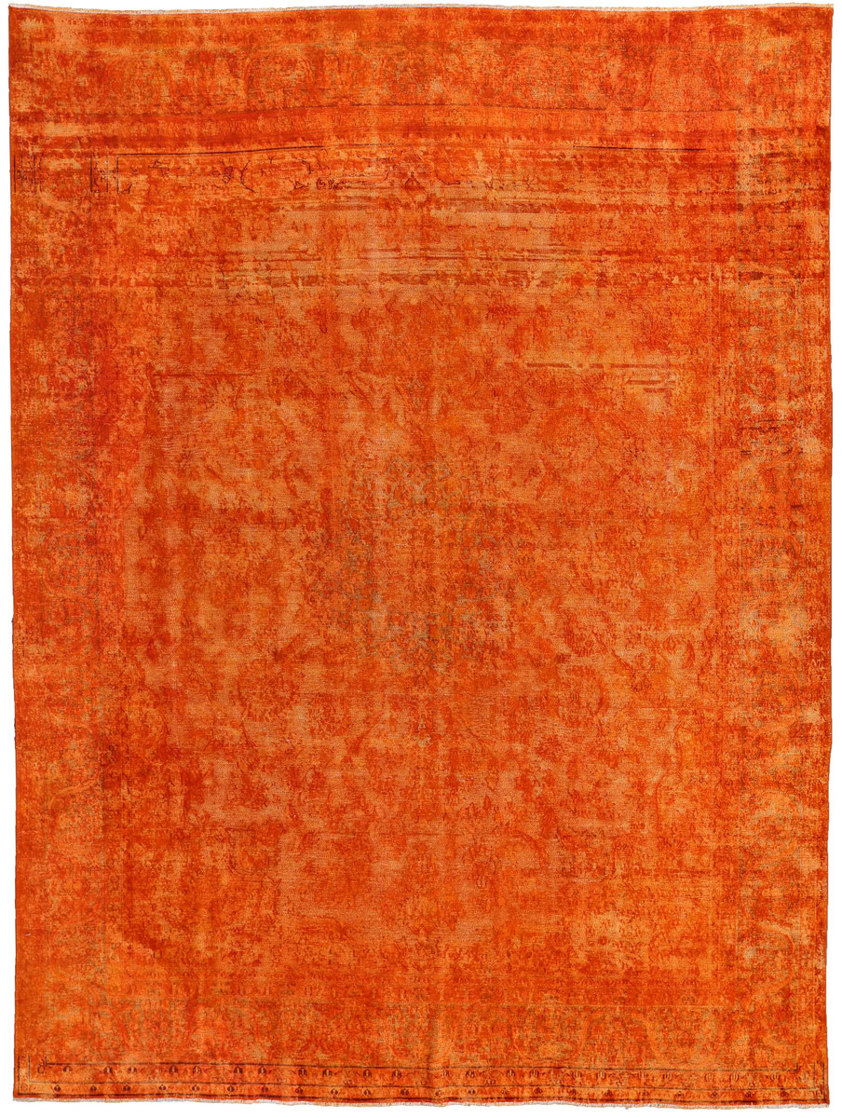
Vivid orange colour is the defining feature of this vintage Persian overdyed rug. Subtle floral traces remain visible within the broad field, their outlines shifting between brighter orange and deeper rust tones. Faint rectangular bands suggest the enclosing border structure. The pattern is subdued compared with the strength of the colour, becoming clearer nearby where small local changes can be followed. Horizontal tonal variation and broader lighter passages give the surface depth. From farther away, it reads as a warm continuous area; at closer range, the underlying ornament adds another level of detail. Persian carpet design includes richly patterned floral fields set within layered borders.
Even where later colouring reduces the contrast of individual motifs, that underlying organisation can remain visible through enclosing lines and traces of branching ornament. Overdyeing changes a carpet's colour relationships, but the designation alone does not establish its original region within Iran, exact age or fibre. Here, the historical design connection lies in those surviving floral and border elements, with the orange providing the dominant contemporary decorative emphasis rather than evidence for a particular traditional palette.
This rug could supply a strong focus beside cream upholstery, pale stone or dark timber. Rust-coloured ceramics would relate to the deeper passages, while plain surrounding textiles would give the orange room to register. An open placement would reveal the tonal changes across the broad middle, and exposed margins would allow the faint enclosing bands to remain visible as part of the complete rectangle.