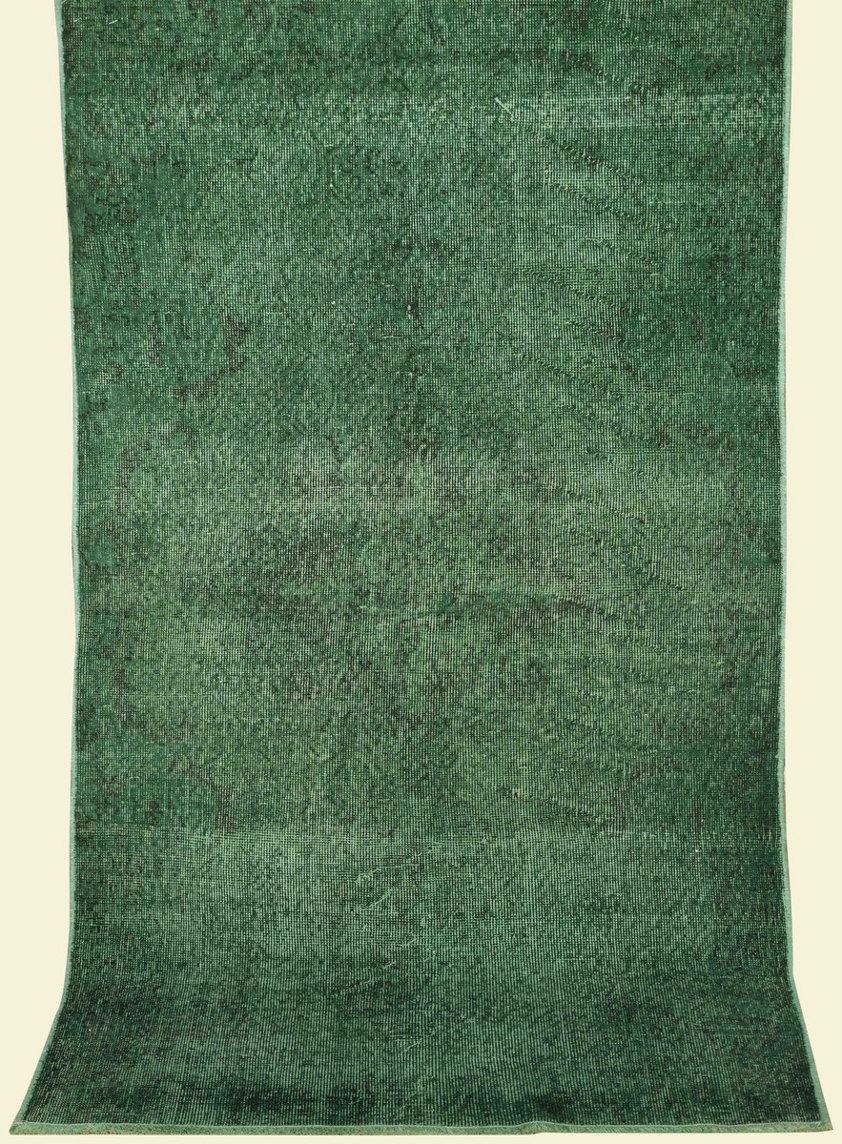
Rich green is the defining feature of this rug. Its colour varies from a softer mid-green through the centre to deeper, almost bottle-green passages towards the edges. The underlying ornament is faint, with the suggestion of a central arrangement visible within the mottled surface. Darker tonal bands mark the perimeter, but no strong line divides the field from its frame. The quietness of the pattern makes this rug particularly useful where colour is wanted without a crisply outlined floral design. Seen from a distance, it reads as a concentrated area of green. Closer inspection reveals smaller changes of tone and traces of ornament, giving the surface more depth than an entirely plain piece would offer.
Persian weaving has produced a wide range of patterned fields, from clearly centralised medallions to continuous floral repeats. The overdyed treatment of a vintage rug can change the balance between drawing and colour, bringing previously separate parts into a closely unified palette. Here, the remaining tonal pattern provides a gentle structure beneath the dominant green rather than a competing focal feature.
At 202 × 114 cm, this rug could sit alongside a bed or introduce green to a small reading area. Warm oak and brass would complement the deeper colouring, while pale walls would keep the setting light. Fabrics in oatmeal or stone would provide a useful contrast, allowing the subtle pattern to emerge without adding further strong colours around it.