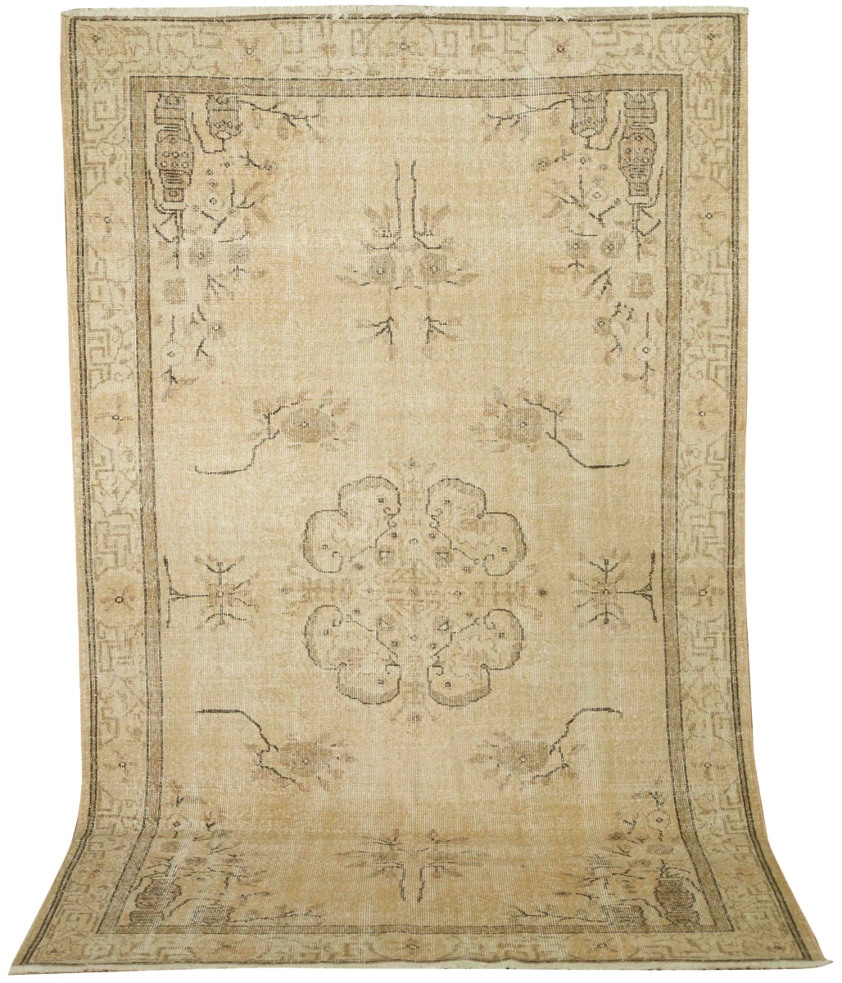
There is an almost sketch-like economy to the drawing of this rug. A small rounded medallion sits within the pale field, its outline composed of lobed curves around a tiny central flower. Widely spaced stems and isolated blossoms extend above and beside it, leaving substantial areas of pale beige visible. The border is broader and more geometric, with angular turns and small compartment-like shapes set between fine parallel lines. Dark brown-grey details are strongest in a few of the scattered motifs, rather than distributed evenly across the whole surface. Elsewhere the ornament is faint, giving the overdyed palette a softly interrupted appearance.
The contrast between the spare interior and the enclosing angular frame is more distinctive than any single colour accent. This rug measures 278 × 170 cm. Its open field could offer relief in a room with busy shelving, patterned upholstery or richly grained wood. A low table placed away from the medallion would preserve the small centre as a point of interest. Stone, linen and softly finished timber would suit the pale ground and the restrained linework.
Persian carpet design is not confined to densely filled floral fields. Its repertoire also includes compositions organised around a medallion, with the surrounding space playing an active part in the balance. The use of borders to contain that space is a longstanding convention. Here, the quiet centre and comparatively architectural perimeter give a familiar Persian arrangement an unusually understated decorative character.