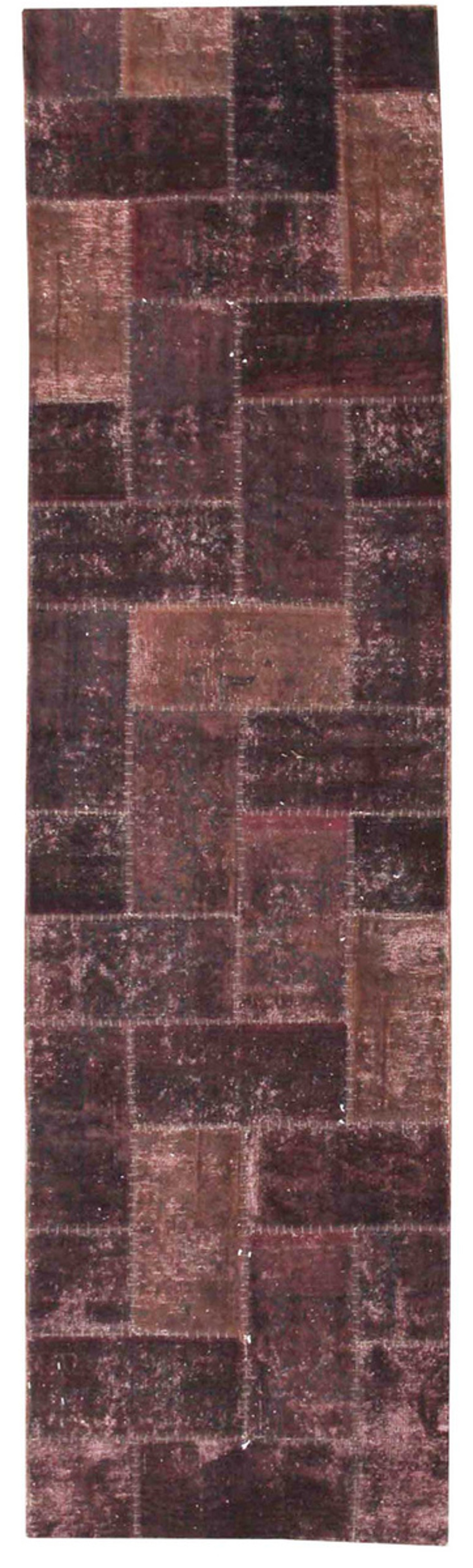
Deep burgundy and brown give this runner a warm, closely coloured patchwork. Smaller rose-brown panels sit between the darker rectangles, bringing light into the arrangement without introducing a separate pale ground. Several sections retain softly visible floral drawing, while others read more simply as broad passages of colour. The panel sizes change along the length. Near-square pieces meet long upright rectangles, and shorter crosswise sections break their alignment. This runner therefore has a varied pace even though its palette is restrained.
The darker blocks are distributed through the composition, keeping the eye moving from one end to the other rather than concentrating attention in a central medallion. In a hallway with warm timber or terracotta flooring, this runner could provide a deeper layer of red-brown colour. Its 81 by 315 centimetre format would also work beside a long cupboard or along a landing. Pale walls would allow the smaller rose sections to stand out, while dark furniture would draw attention to the subtle differences within the burgundy.
The floral fragments visible in this Afghan runner are handled differently from a continuous carpet field, their spacing determined by the larger arrangement of panels. Here, floral passages are separated into individual rectangles, so the drawing contributes texture to a larger composition of straight edges. This runner is particularly successful in the balance between those angular divisions and the quieter curved lines still visible within them. Its richness comes from their close tonal relationship.