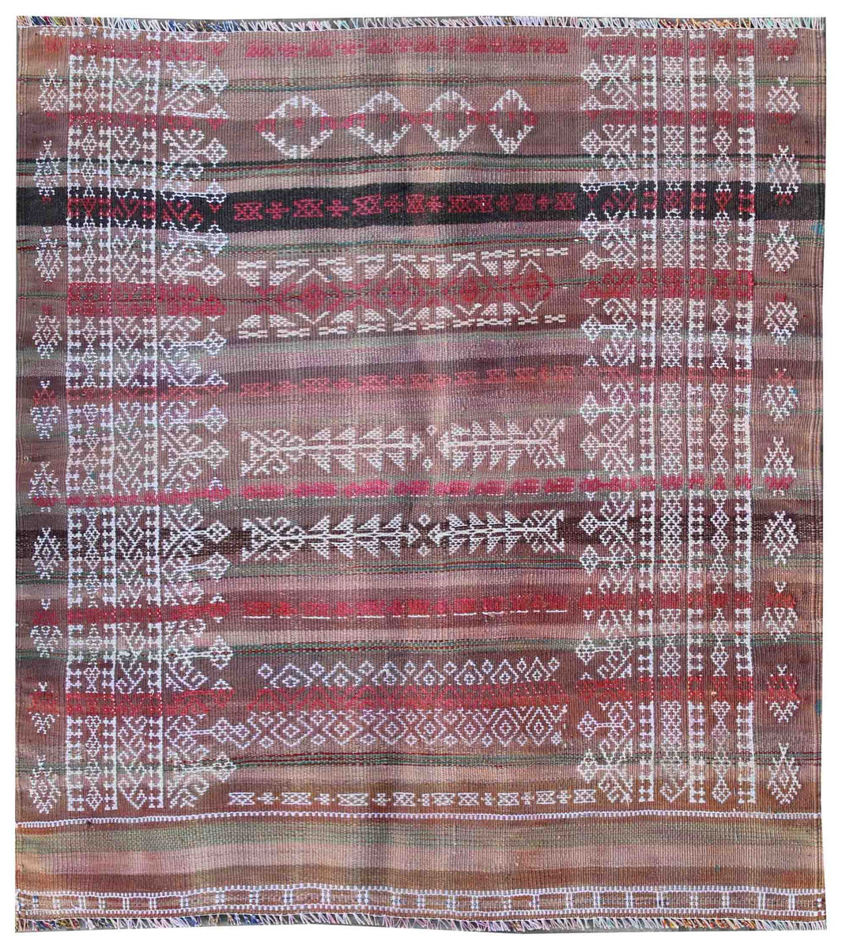
Fine white lines create an intricate pattern across the muted bands of this rug. Diamonds, little hooked forms and narrow branching motifs alternate along the field, with denser runs of ornament at the sides. The ground moves between soft red, brown, grey and dark blue, allowing the white drawing to change in clarity from one band to the next. Narrow striped ends finish the compact composition. Anatolia, the Asian part of Türkiye, has a substantial history of flatwoven furnishings made in village and nomadic settings.
Kilim designs frequently turn geometric outlines into rhythmic fields, with changes of banding and motif giving each textile its character. This vintage example shows that relationship particularly well through its fine pale drawing and gently varied background. At 131 × 117 cm, this rug is relatively broad for its length. It could introduce detail beside an armchair or within a small open area in a study.
Plain upholstery would let the little geometric shapes remain distinct, while dark timber could pick up the deeper horizontal bands. The most appealing contrasts are small ones. A white diamond may sit against a muted red stripe, then a similar mark nearly merges into a lighter grey passage nearby. That shifting visibility gives the surface a lively quality without strong blocks of colour. Leaving its edges in view would also show the relationship between the fine field ornament, the more concentrated side details and the simple striped endings.