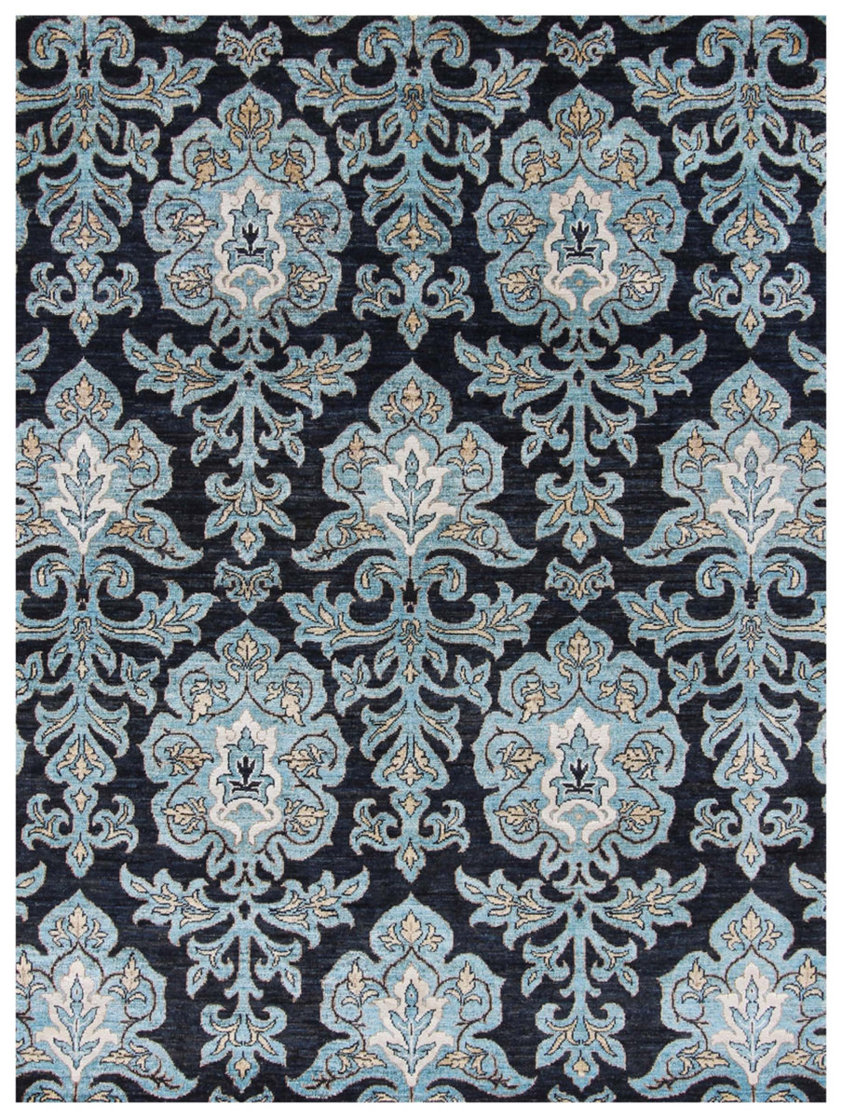
Large pale blue floral forms stand out against the dark ground of this rug. Their lobed outlines contain smaller cream and golden details, while curling stems connect them to neighbouring leaves and flower heads. The repeat is bold and spacious enough for the principal forms to remain clear, even where the foliage becomes more intricate. The Arts and Crafts reference belongs to a design movement in which stylised plant forms and a strong interest in historical textiles were especially important. William Morris studied Persian carpets closely when developing his own carpet designs in the late nineteenth century.
This Afghan rug draws on that wider decorative relationship, combining a regular botanical repeat with an emphatic dark-and-light contrast. This rug would sit particularly well with oak, painted panelling or plain upholstery. A pale blue chair could relate to the main flowers, while warm white walls would draw attention to the smaller cream details. At 148 by 203 centimetres, it could define a compact seating group or bring a substantial patterned area to a study.
There is no single central medallion. Instead, the large floral forms establish a rhythm across the rectangle, with the dark ground opening between their curling outlines. The design remains recognisable when part of the field is covered by furniture. This rug is most distinctive where the broad blue petals meet the finer branching details, giving it both immediate presence and closer ornamental interest.