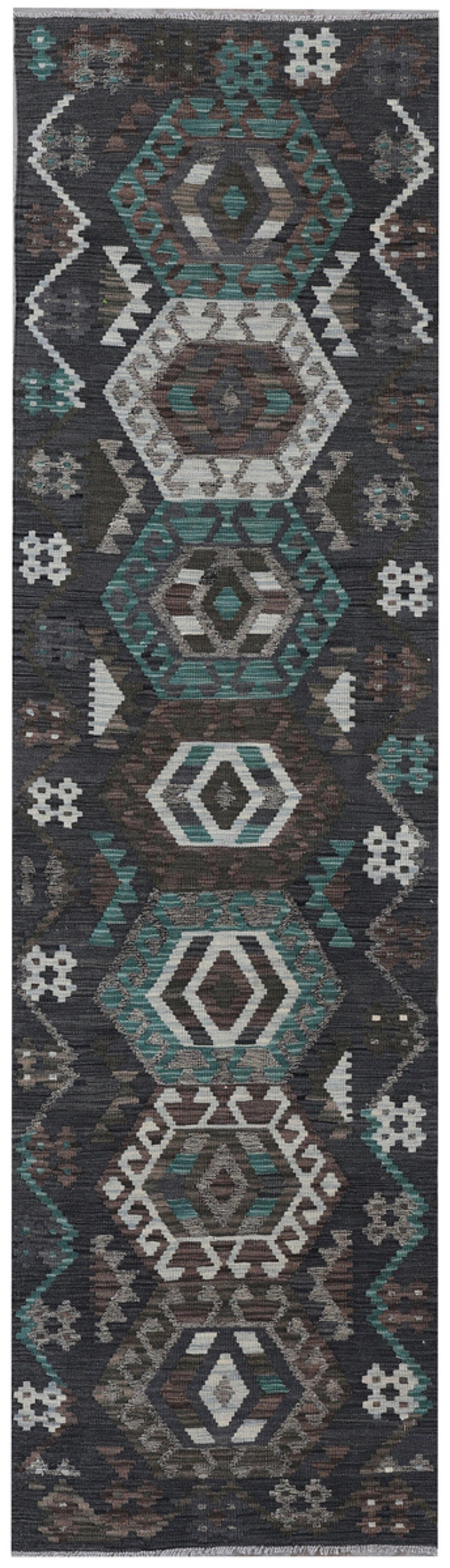
Seven varied hexagonal centres extend along this Afghan kilim runner. Cream and turquoise bands stand against a dark charcoal ground, with muted brown, grey and olive details inside the larger forms. Some centres are broadly layered, while others have simpler pale diamond interiors. Small flower-like geometric units appear at the sides, accompanied by narrow turning lines and scattered lighter marks. The changes between medallions give the length a deliberate visual progression. Cream is concentrated strongly around some enclosures and more sparingly around others.
Turquoise connects the separate centres without making them identical. Fine horizontal colour shifts add depth within the dark field, and the small side figures keep the areas beyond the central sequence decorative rather than empty. Kilim weaving produces a flat patterned cloth from coloured wefts interlaced with the warp. It has no knotted-pile layer. Repeated outlines can contain many different arrangements of colour and detail, especially in an elongated textile.
This runner uses that flexibility to establish continuity along its length while allowing each hexagon to introduce a different balance of light and dark within the shared geometric vocabulary. Against light flooring, the dark ground would give the whole sequence definition. Cream walls and natural timber could provide a quiet setting, with muted green accessories relating to the turquoise bands. Furniture placed alongside the runner would preserve the succession of centres and leave the small pale side figures visible at closer range.