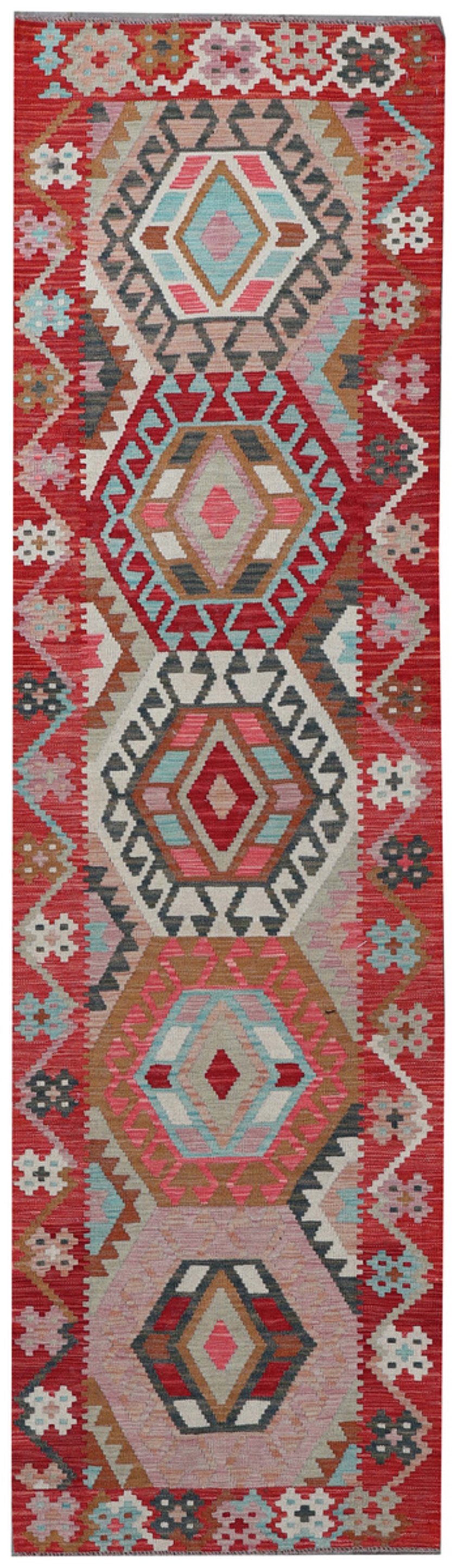
Five broad hexagons create a long central sequence on this Afghan kilim rug. Their interiors change between blue, salmon, red, ochre and cream, each enclosed by angular bands. The outer outlines vary from dark grey hooks to pale blue and green, giving every medallion its own emphasis. Small multicoloured roundels repeat down the red side areas and across the ends. The length makes the progression of centres particularly important. Some contain a simple nested diamond; others introduce wider stripes or smaller contrasting figures.
Cream intervals keep the stronger colours separate, while fine horizontal changes soften the red field. The border's compact units provide continuity around the more varied middle, finishing the design with an easily followed perimeter rhythm. A kilim's pattern is woven into its flat structure using coloured wefts around supporting warp threads. There is no knotted pile. Repetition in this tradition need not mean identical contents: a recurring outline can hold different colour arrangements along a textile.
Here, the sequence of hexagons illustrates that flexibility, with the border supplying a smaller shared unit that connects the whole composition. This rug would make effective use of a long open floor area. Pale walls could give the red field room, while dark timber would relate to several medallion outlines. Positioning furniture beside its length would keep the changing centres readable and allow the roundel edging to remain visible along both sides.