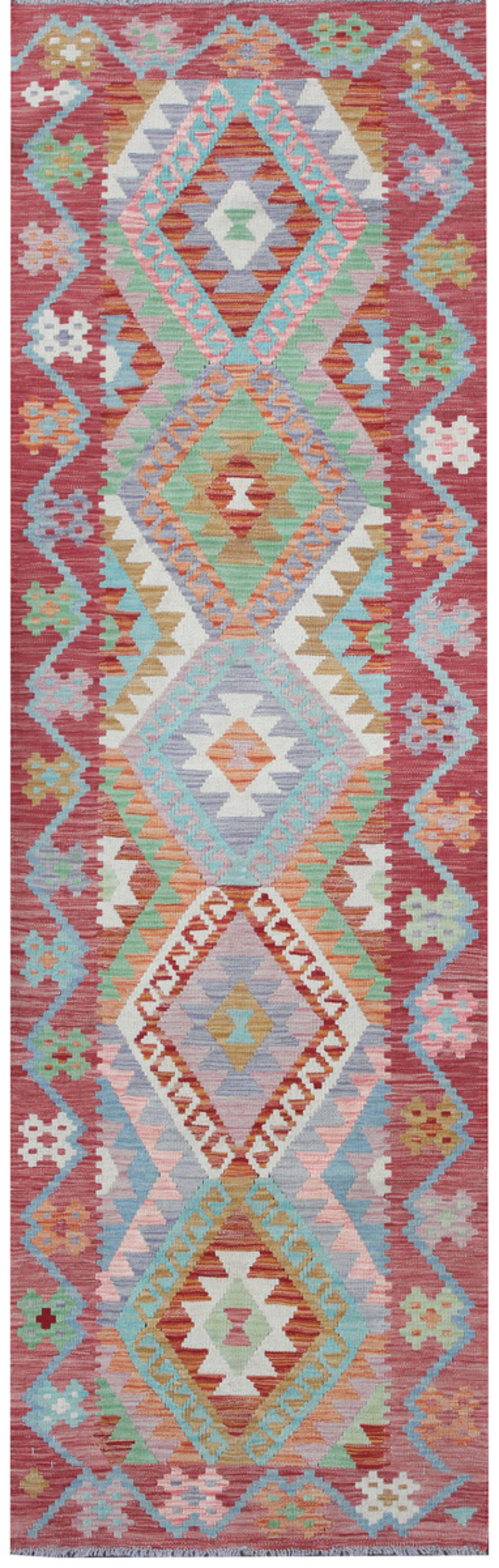
An elongated chain of large diamonds runs through the coral field of this Afghan kilim rug. Pale blue outlines connect the principal forms, while green, cream, ochre and soft pink details fill their centres. Smaller geometric motifs appear along the sides, giving the narrow composition a lively edge. The strongest colour is the warm coral background, balanced by the cooler tones within the central pattern. The diamonds change internally as the eye moves along the rug. Some contain nested shapes; others have smaller stepped or star-like centres.
Their repeated outer form keeps the arrangement coherent. Horizontal variations of colour are visible across the flat surface, adding another layer of interest to the crisp geometry. Narrow end bands finish the pattern without creating a heavy outer frame. Flatweaving is central to the definition of a kilim. Coloured weft threads cross the warp to form the surface, producing a textile without a knotted pile. The construction lends itself to stepped diagonals and angular motifs, including the linked diamonds seen in many geometric designs.
Afghan kilims sit within a broad textile culture whose furnishings vary in colour, format and ornament. This rug's long proportions could work beside a bed, through a smaller passage or along the edge of a seating space. Pale furniture would draw out its softer colours, while warm wood would complement the coral. Leaving the central chain unobstructed would make the directional quality most effective and allow the changing details to be enjoyed along its length.