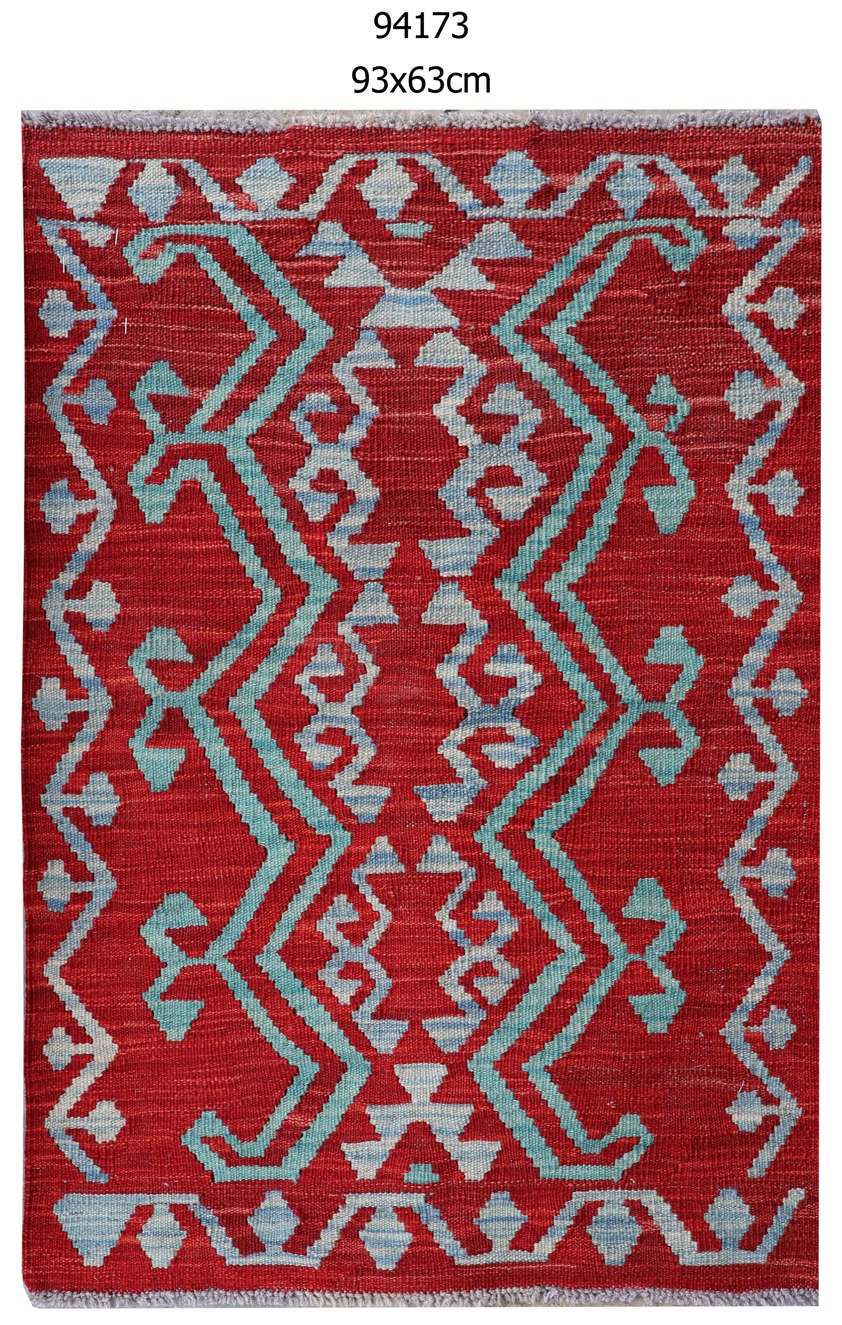
Turquoise scrolling lines define two open diamond forms on the red field of this Afghan kilim rug. Smaller pale blue hooks turn towards the middle, while short turquoise and cream units occupy the surrounding spaces. A narrow angular line follows the perimeter. The centres are not densely filled, allowing the red ground to remain a substantial part of the overall decorative effect. The turquoise drawing is broad enough to read clearly from a distance. Its stepped edges and inward-turning hooks introduce movement without relying on a large number of different colours.
Fine horizontal variation gives the red a textured appearance. Small pale marks near the ends provide lighter pauses, connecting the central outlines with the more restrained enclosing line around them. Kilim weaving forms an unpiled cloth through coloured wefts interlaced with warp threads. Pattern can be expressed through open line as well as solid bands of colour. In a design such as this, the ground is active: its visible intervals separate neighbouring hooks and make the large outlines legible.
The shared angular vocabulary links the principal motifs with the finer perimeter details. This rug could provide a strong colour accent beside simple cream seating or pale floorboards. A turquoise ceramic would relate directly to the main drawing, while dark timber could offer a quieter companion to the red. Keeping the centre uncovered would preserve the open geometry and allow the smaller inward-turning hooks to remain visible nearby.