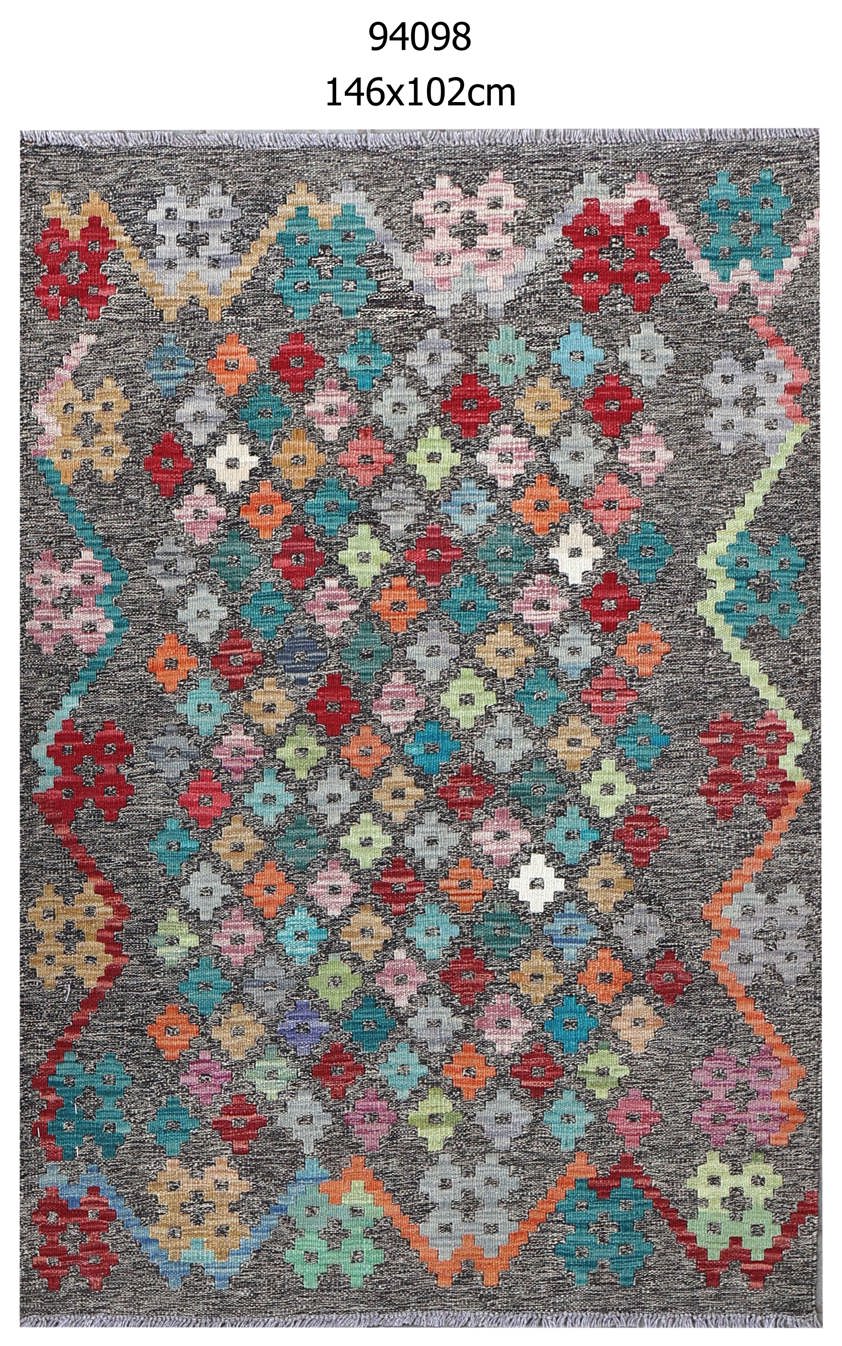
Tiny multicoloured diamonds cover the charcoal ground of this Afghan kilim rug. Turquoise, red, pink, cream, orange and soft yellow centres change across the closely arranged field. Larger geometric compartments mark the sides and ends, creating a gradual shift in scale around the denser middle. The dark ground is visible between the pale outlines, helping each small colour remain distinct. The overall effect is finely patterned rather than centred on one dominant medallion. Some units are strongly contrasted, while others merge more gently into grey. Small horizontal tonal variations add further movement beneath the repeat.
Looking across the surface reveals changing clusters of bright and quiet colour, with the larger outer motifs acting as intervals around the miniature central figures. A kilim's ornament develops within its flatwoven structure. Coloured transverse wefts interlace with the lengthwise warp, forming fabric without knotted pile. Repeated angular units can be arranged into a continuous field, and their contents may vary considerably while the underlying framework remains recognisable.
This rug illustrates that relationship between a consistent geometric plan and many local differences of colour and proportion. Plain upholstery would give the intricate surface room to register. A charcoal chair could connect with the ground, while one turquoise or coral accessory would pick out a brighter group of motifs. The all-over arrangement also offers flexibility around furniture, since the exposed areas retain varied detail even when part of the middle is covered.