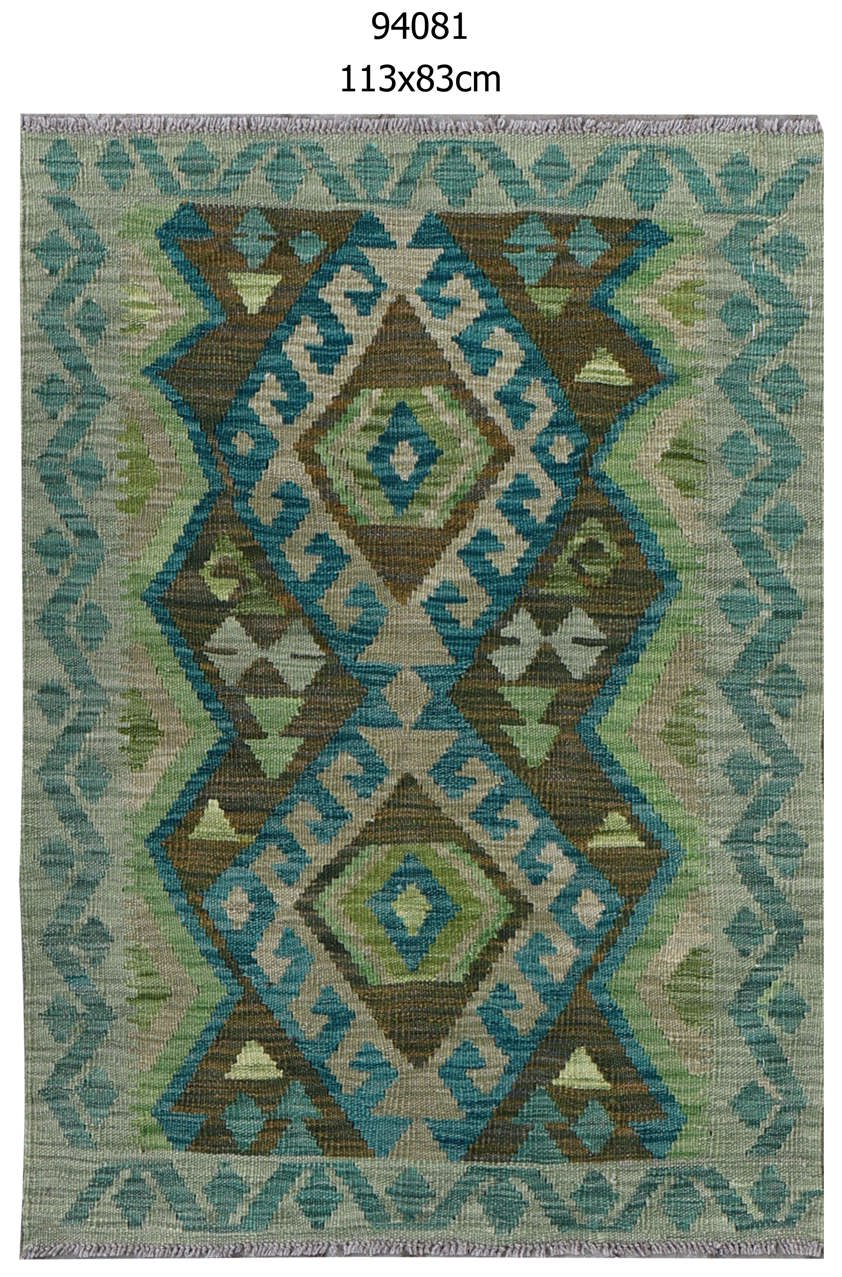
Olive and turquoise give this Afghan kilim rug its distinctive tonal character. Two nested medallions run along the centre, each containing a small blue-green diamond within broader pale bands. Turquoise hooks articulate the outside of the olive shapes. Separate light geometric figures occupy the sides, and a narrow sequence of related units finishes the perimeter. The colours are close enough for the design to emerge gradually. Dark olive gives weight to the principal enclosures, while pale cream and green create intervals around their interiors. Horizontal shading crosses the field and broad bands.
From a distance the paired structure is apparent; nearby, the smaller hooks and changes within each centre provide a finer level of interest. A kilim's flat surface is formed by interlacing coloured wefts with warp threads, with no added knotted pile. Its geometric language can accommodate large nested forms and tiny independent motifs within the same cloth. In this example, changes of scale distinguish the central pair from the surrounding figures, while repeated greens connect the different parts.
The general weaving tradition explains the structure without assigning symbolic meanings to particular motifs. This rug could sit comfortably beside oak furniture, warm grey upholstery or a cream-painted wall. A turquoise ceramic would draw attention to its finer outlines. An open position at the foot of a chair would reveal both centres, with enough surrounding floor to distinguish the narrow patterned edge from the softly blended field.