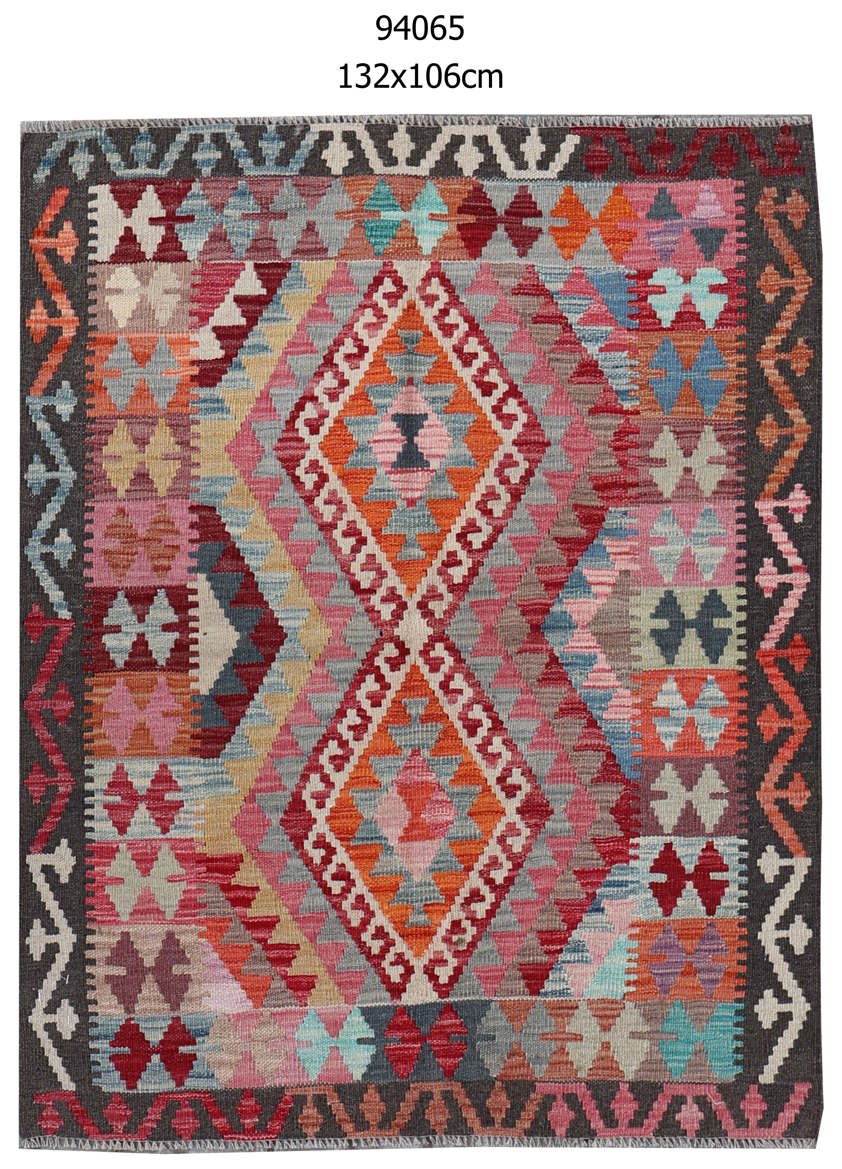
Red hooked centres form a strong pair on this Afghan kilim rug. Cream bands surround their smaller geometric interiors, with pale blue and pink steps expanding towards the sides. Multicoloured angular units fill the surrounding field. A dark frame carries turning lines and compact figures, giving the brightly layered middle a clearly defined enclosing boundary without repeating the same pattern density throughout. Fine horizontal shading softens the red and blue. Orange and green details create smaller points of emphasis within the centres. The two medallions share their outline but vary inside, while the surrounding figures change in colour and scale.
Narrow end details finish the rectangle and connect the dark border with the lighter central layers through recurring pale lines and repeated angular shapes. Kilim construction makes pattern through coloured wefts crossing warp threads. It forms a flat textile without knotted pile. A stepped boundary can become a broad enclosing band, a finer hook or a small isolated unit. Afghan kilims combine these structural relationships to organise elaborate fields, maintaining a coherent overall plan while allowing individual centres and supporting motifs to vary in shade and detail.
This rug would work with plain cream fabrics and natural timber furniture. Blue or pink accessories could echo selected bands, while dark wood would relate to the frame. A table with slender legs would preserve more of the hooked interiors. Quiet walls would give the stronger central colours room to stand out and keep the smaller perimeter figures visible nearby.