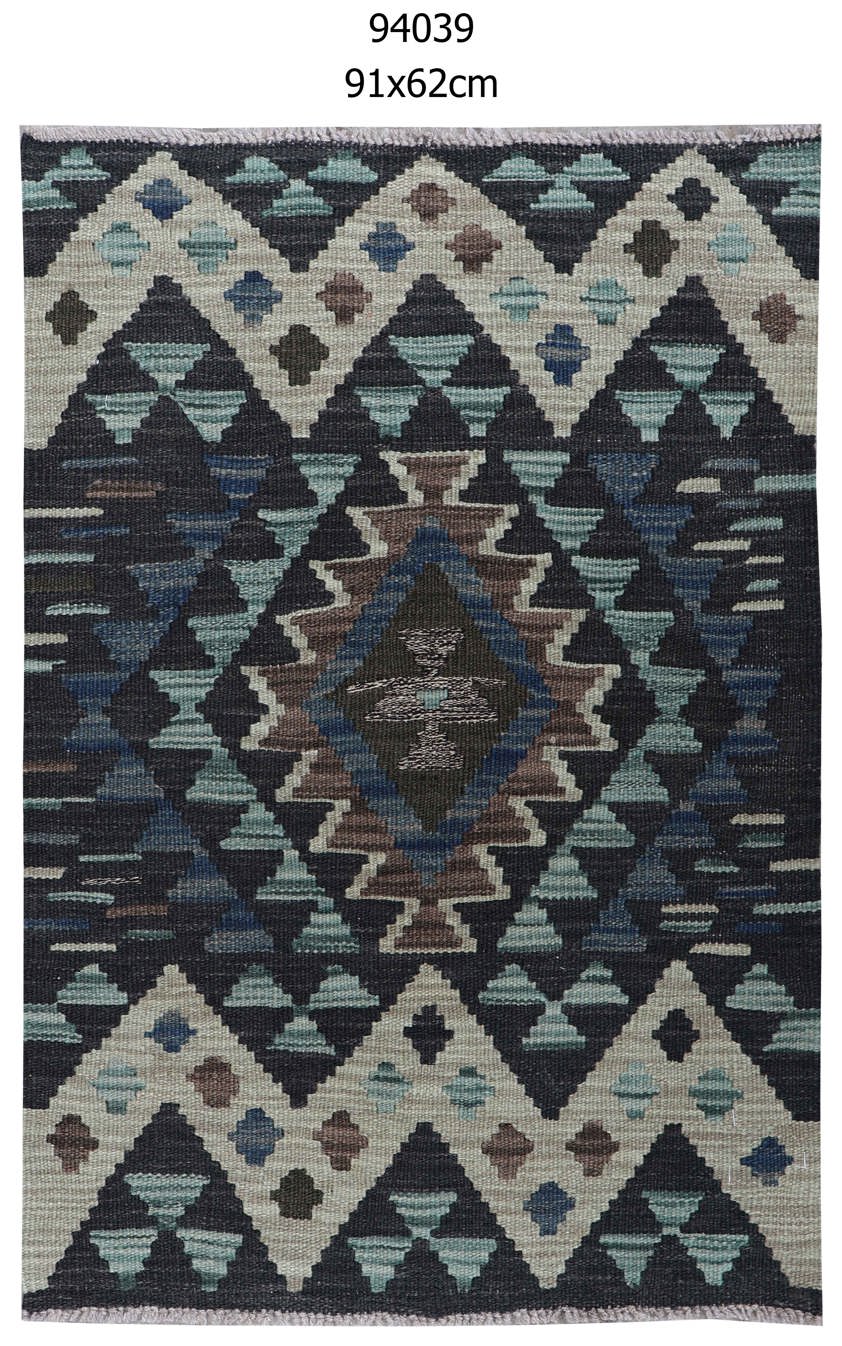
A pale central diamond stands against navy on this Afghan kilim rug. Blue, grey and warm neutral bands lead towards its smaller dark interior, while broad cream angular shapes fill the upper and lower sections. Small pale blue figures occupy the side areas. The design has one dominant centre, supported by a wider rhythm of stepped and interlocking forms around it. Fine horizontal shading is visible through the blue and grey. Cream provides the strongest contrast, making the principal outline and end bands clear from a distance.
The inner layers become more apparent nearby, where their differences of tone can be followed. A narrow outer finish keeps the focus on the central diamond and surrounding angular divisions rather than a separate patterned border. A kilim is a flatwoven textile whose coloured wefts produce both fabric and ornament around the supporting warp. Its surface has no knotted pile. The stepped vocabulary accommodates sharply different scales: a narrow band can enclose a small centre, then widen into a dominant diamond.
In this rug the broad cream end shapes extend that geometry, giving the darker middle a distinctly architectural setting within the rectangle. This rug would suit plain cream fabrics, natural timber and quiet grey walls. Blue accessories could echo the inner bands, while dark wood would connect with the ground. Keeping the central diamond uncovered would preserve its layered effect. A bedside or reading corner would allow the smaller side figures and fine horizontal colour changes to remain visible nearby.