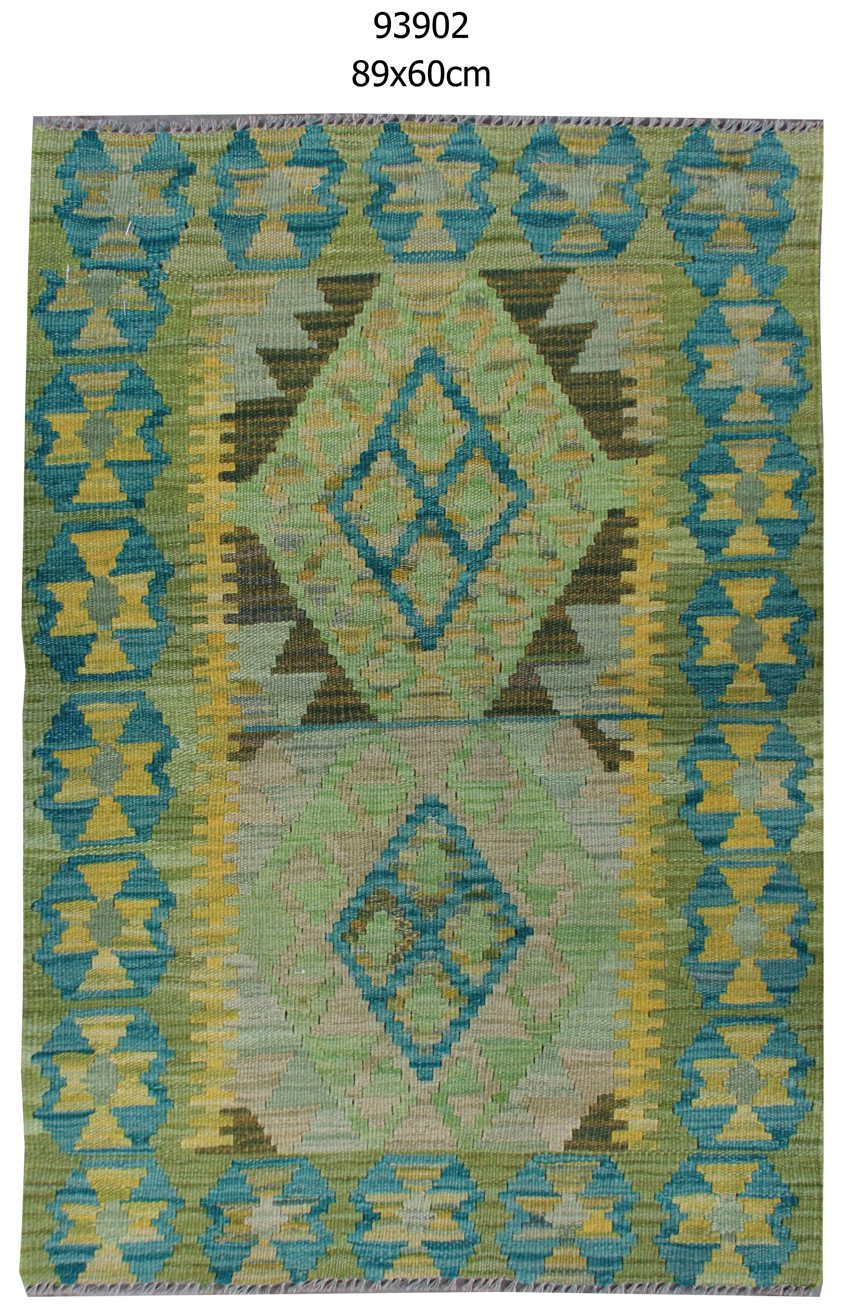
Blue roundels frame the yellow-green field of this Afghan kilim rug. Their small pale centres repeat at a steady pace around the perimeter. Inside them, two finely outlined blue diamonds contain muted green and cream figures. Olive pointed areas extend towards the sides, giving the central pair more definition within the closely related background colours. Fine horizontal shading is visible through yellow, green and blue. The upper and lower diamonds differ slightly in their internal details, while the border provides a more regular surrounding rhythm. Pale bands lighten the middle and connect with the roundel centres.
A narrow outer edge completes the rectangle without competing with the stronger distinction between the layered field and compact perimeter units. The roundel frame illustrates how a kilim can give its border an identity of its own. In this weaving tradition, transverse coloured threads build the visible pattern as they pass over and under the longitudinal warp. There is no added knotted pile. Large stepped outlines and smaller enclosed figures belong to the same geometric repertoire, but changing their proportions creates a distinction between field and edging.
This rug would work with pale wood, cream fabrics and muted green upholstery. Blue ceramics could echo the outlines and roundels, while plain walls would give the softly shaded ground room to register. An uncovered position beside a bed or chair would preserve the central pair. Keeping the full frame visible would show its measured sequence and the smaller colour variations inside each blue enclosure.