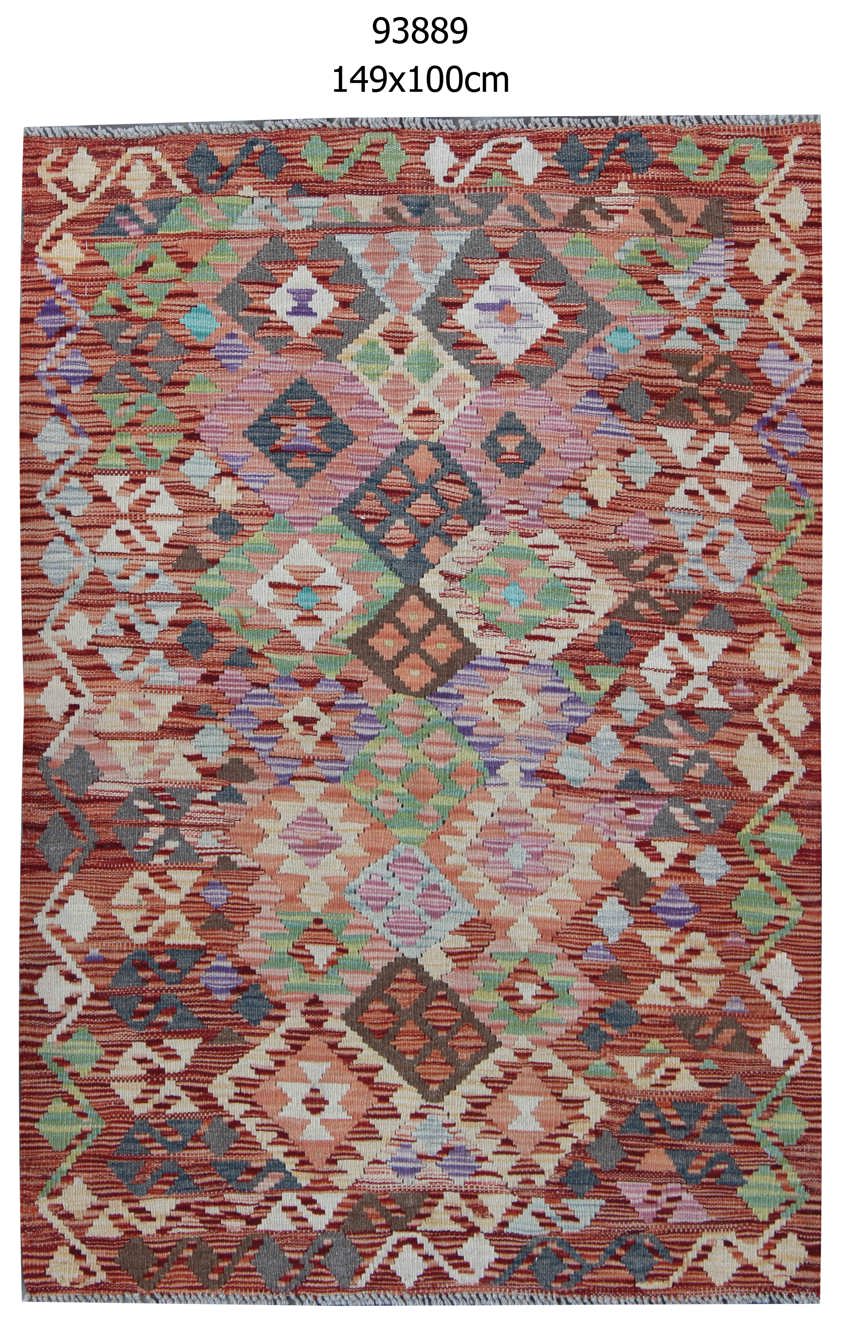
A mosaic of multicoloured diamonds fills this Afghan kilim rug. Pale blue, green, red, cream and muted pink centres change across the field, enclosed by narrow stepped bands. Small angular figures occupy the spaces between the larger compartments. A warm red frame carries pale turning lines, gathering the varied motifs into a clear rectangle without introducing an unrelated border design. Some diamonds have dark, compact interiors, while others are lighter and more openly layered. Fine horizontal changes add depth within the blue and red areas.
The repeat distributes attention across the whole surface rather than towards one dominant centre. From a distance the connected framework is the strongest feature, while nearby the changing internal figures and finer pale dividers become easier to distinguish. Kilim flatweaving creates pattern through coloured wefts interlaced with warp threads. It forms a flat textile without knotted pile. Stepped boundaries can join neighbouring compartments while their interiors vary.
Afghan kilims use this relationship between repeated structure and changing detail to organise richly coloured fields, allowing a broad palette to remain coherent within a shared angular vocabulary. Set beside a simple sofa, this rug could supply most of a room’s colour. A terracotta cushion would relate to its frame, and a green chair could pick out one of the quieter internal shades. Slender table legs would leave the mosaic easy to read. The small scale of the connecting figures also rewards a position where the surface can be appreciated at close range.