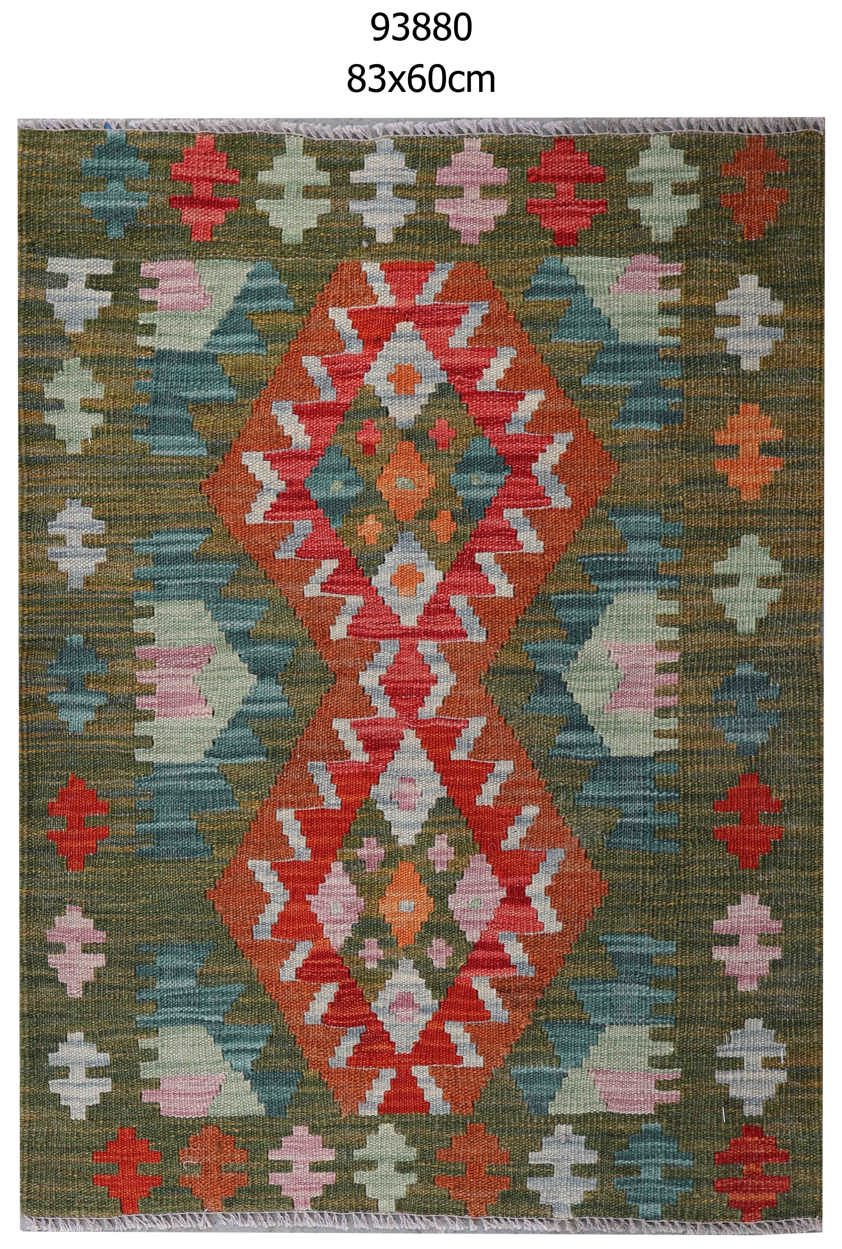
Red medallions stand against the olive ground of this Afghan kilim rug. Pale stepped outlines surround smaller green, orange and cream figures, forming a clear vertical pair. Separate angular units repeat at the sides and ends in cream, pink, red and warm neutral tones. The darker green field gives the warm centres a distinct setting without requiring a broad contrasting outer border. Fine horizontal shading adds depth to the olive and red. Pale lines are strongest around the medallion edges, clarifying their pointed shape.
Small differences inside the upper and lower centres keep them individually recognisable within the paired plan. The side figures are more widely spaced, giving the denser middle room while maintaining a related geometric rhythm around the perimeter. The arrangement follows the possibilities of kilim flatweaving. Coloured wefts cross the warp to create a patterned flat textile without knotted pile. A stepped boundary can enlarge a small internal figure into a dominant motif, while related compact units organise the surrounding field. Afghan kilims use this balance of scale and repetition to connect clear central forms with fine variations of shade and internal detail.
This rug would complement natural timber, plain cream fabrics and muted green upholstery. A small red or terracotta accessory could echo the centres, while quiet walls would give the darker field definition. Keeping both medallions uncovered would preserve their differences. The open side areas would remain an engaging source of smaller colour accents when the rug is viewed nearby.