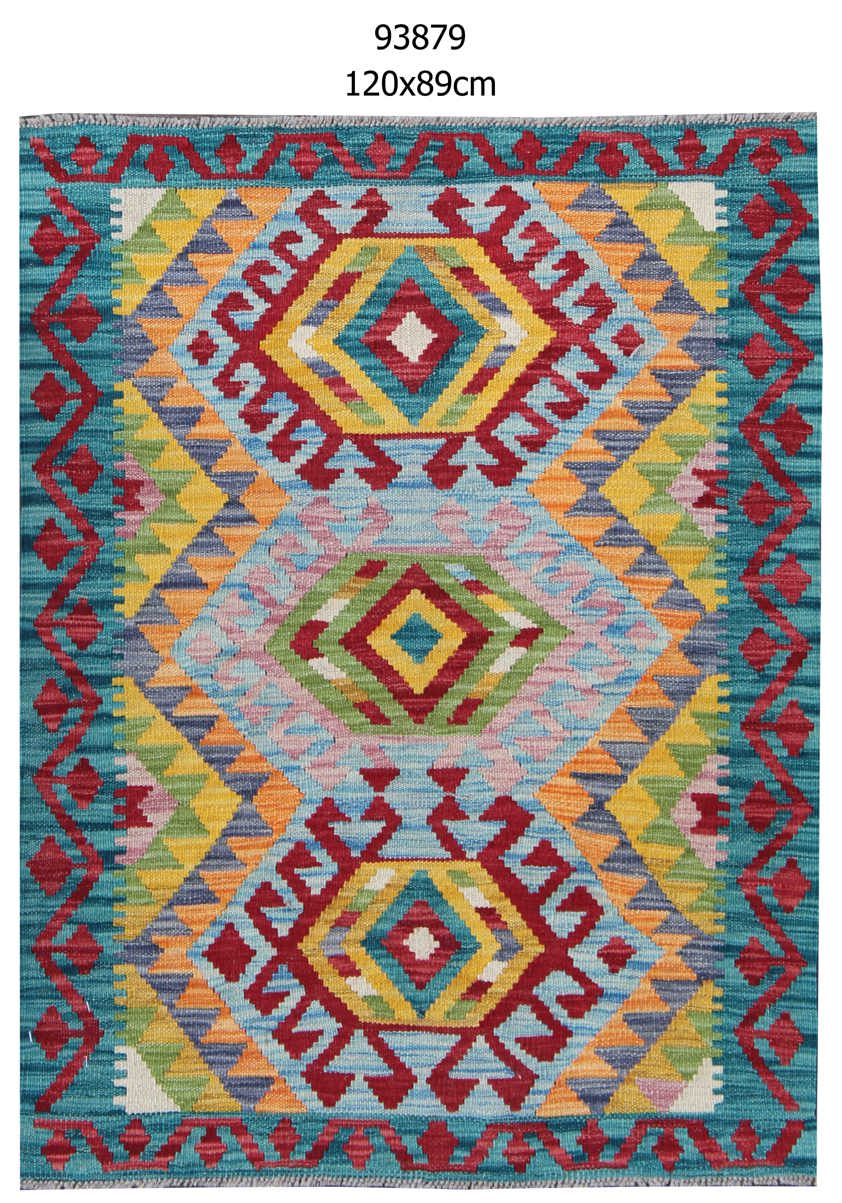
Three bright centres run through the turquoise field of this Afghan kilim rug. The upper and lower medallions contain red hooked outlines around yellow, blue and cream diamonds. A broader middle form introduces green and pink bands, providing a deliberate change of scale. Red turning lines frame the sides, while compact repeated units complete the ends within a clearly defined rectangular arrangement. Fine horizontal colour changes enrich the turquoise and yellow. Pale layers keep the warmer red details distinct, and the different centre shapes prevent the sequence from feeling uniform. Smaller side figures repeat the principal colours at a quicker pace.
The contrast between the broad middle and more compact outer medallions gives the design a measured rhythm along its length. Kilim flatweaving forms a patterned textile through coloured wefts interlaced with warp threads. Its surface has no knotted pile. Nested angular boundaries can be repeated while their internal proportions and colours change. Afghan kilims use this flexibility to create connected sequences, balancing a consistent structural vocabulary with individual differences between principal motifs and the finer details around them.
This rug would work with plain cream upholstery and natural timber. Turquoise accessories could continue the field, while yellow or green details would echo selected bands. An open table would preserve parts of all three centres. Quiet walls would leave space around the stronger colours and allow the red side lines to remain a clear enclosing rhythm around the arrangement.