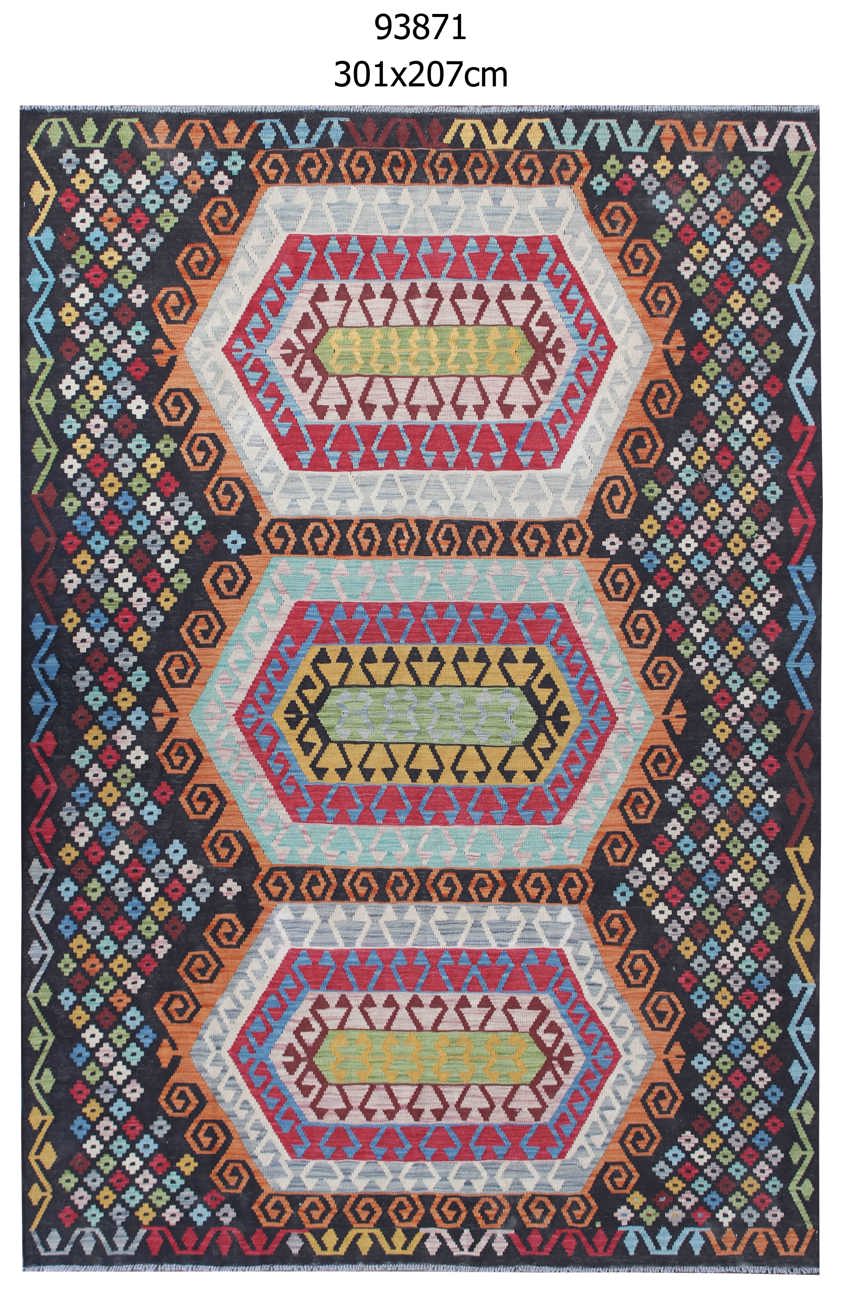
Three large layered hexagons stand against black on this Afghan kilim rug. Pink, pale blue, cream, yellow and red bands surround elongated yellow-green centres. Orange hooked outlines trace the outside of the principal forms. Tiny multicoloured diamonds fill the side areas, and a narrow geometric line follows the perimeter. The contrast between large centres and miniature surrounding units gives the generous composition a particularly clear hierarchy of scale. Fine horizontal changes enrich the pale bands, while black remains a strong common background.
The middle hexagon introduces darker internal outlines, and the upper and lower forms vary their red and blue emphasis. Small pale units mark the ends. Each area repeats related colours, connecting the concentrated central sequence with its finely worked surroundings without making their pattern density identical. Kilim flatweaving forms a patterned textile through coloured wefts interlaced with warp threads. It has no knotted pile.
Nested boundaries can enlarge a small shape into a dominant motif, while the same angular vocabulary can be reduced into tiny supporting units. Afghan kilims use these changes of scale to balance elaborate central forms with coherent all-over detail around them. This rug would make a strong focus within a generous seating arrangement. Plain cream upholstery would relate to the lighter bands, and dark timber could connect with the ground. An open table would preserve parts of all three hexagons. Quiet walls would leave room for the many small coloured side diamonds to remain visible nearby.