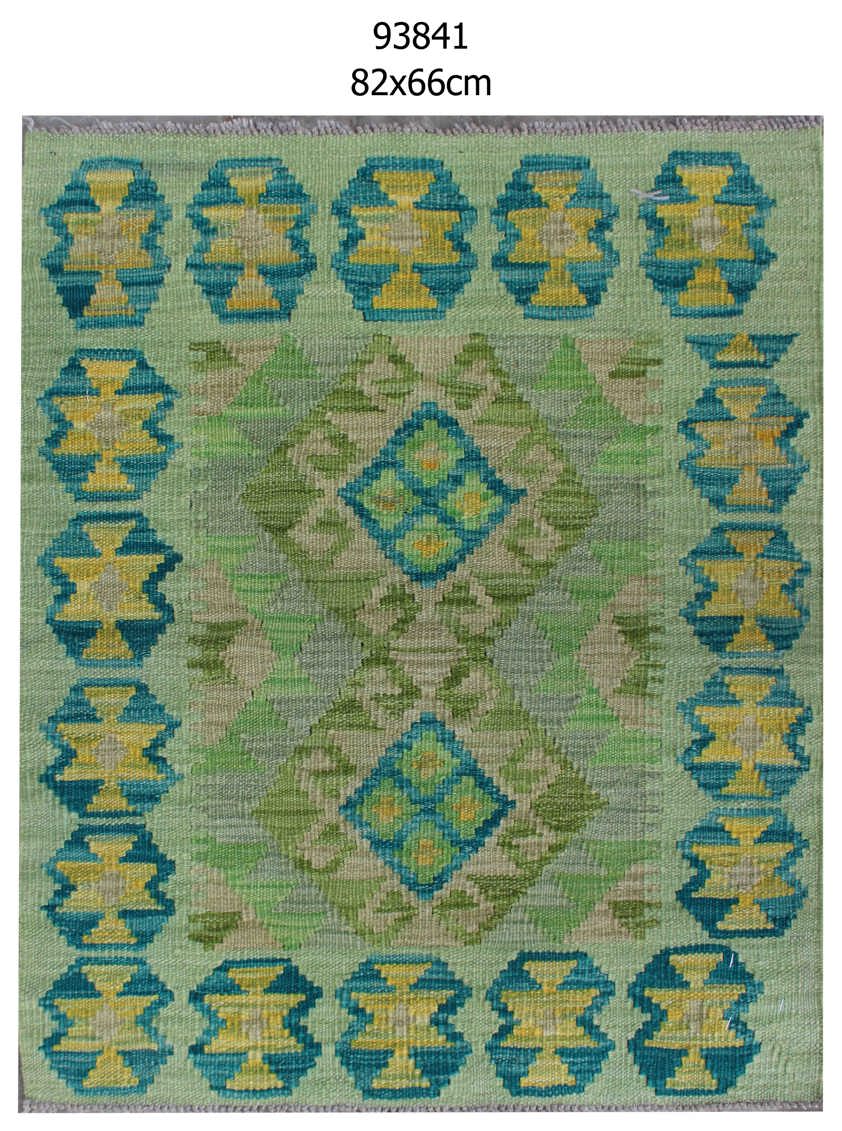
Blue roundels form a complete frame around this Afghan kilim rug. Their small centres vary in yellow, cream and muted green, set against a light green ground. Inside the frame, two compact medallions contain blue and yellow geometric figures within broader olive and pale bands. The border units are more regular than the layered centres, giving the compact design two complementary rhythms. Fine horizontal shading is visible across the green and blue. Pale outlines lift the inner geometry, while darker olive details give the central pair definition. The roundels repeat several field colours at a smaller scale, connecting the frame with the middle. A narrow outer edge finishes the rectangle without distracting from the changing centres of the repeated border units.
Kilim construction creates a patterned flat textile through coloured wefts crossing warp threads. It has no knotted pile. Related angular boundaries can describe a broad medallion or a compact enclosing unit. Afghan kilims use these changes of scale to distinguish the central field from its border, while recurring colours maintain a coherent overall arrangement and allow smaller internal details to vary.
This rug would suit pale timber, cream linen and softly coloured walls. Blue accessories could echo the roundels, and muted green upholstery would continue the natural palette. An uncovered bedside or reading corner would show both centres. Leaving the full frame visible would preserve its measured perimeter rhythm and the subtle changes inside each small blue enclosure.