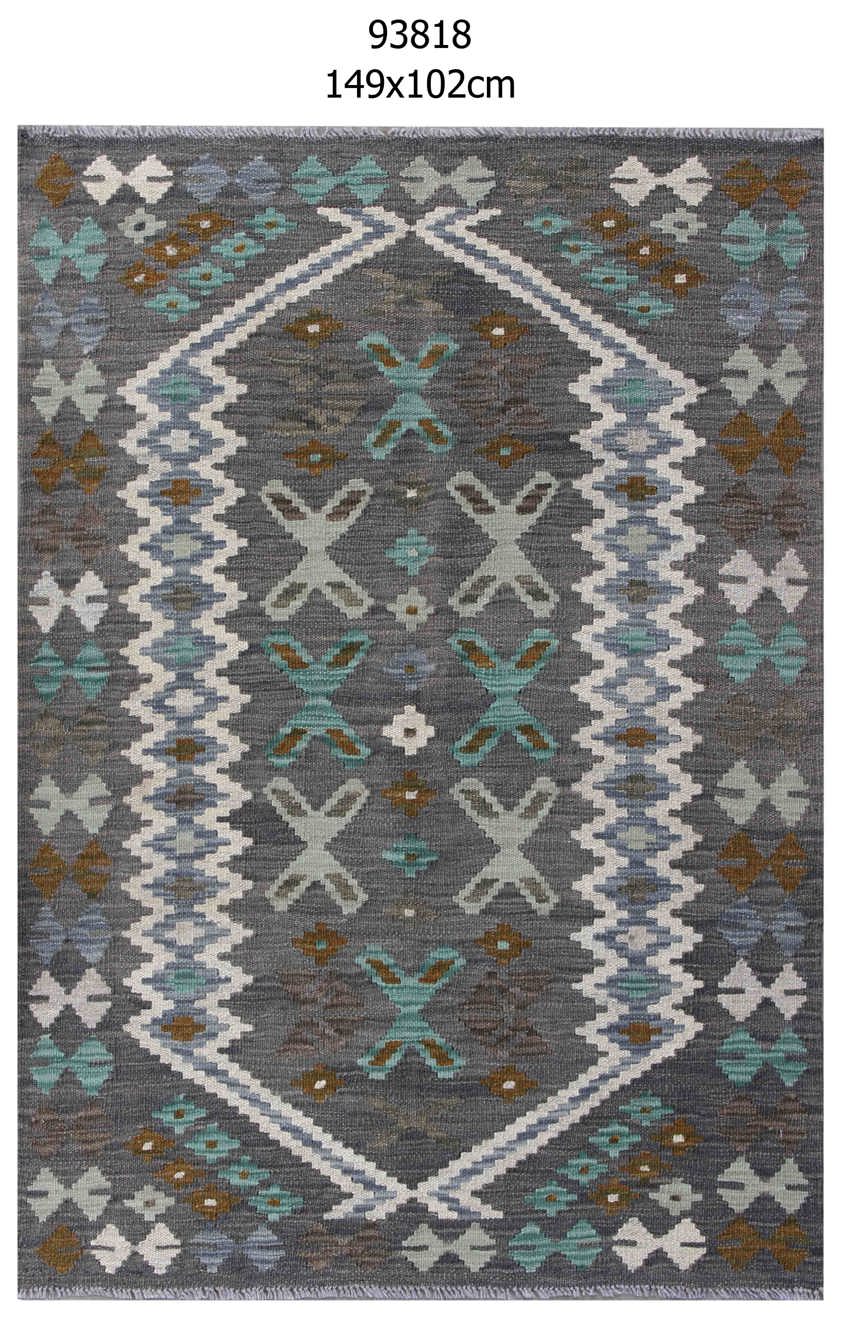
A cream zigzag enclosure frames the central field of this Afghan kilim rug. Grey and muted blue form the background, with small turquoise, olive and pale geometric figures arranged inside the long outline. Separate light units repeat down the sides. The enclosure narrows towards the ends, giving the larger composition a clear direction while leaving room for many small internal variations. Fine horizontal colour changes pass through the grey ground, adding depth within the flat surface. Cream carries the strongest contrast, while turquoise provides quieter cool accents. Some internal emblems are paired, others more compact or branching.
The narrow outer edge allows the long zigzag line and its surrounding figures to supply the principal structure without a heavy separate border. Kilim construction makes pattern through coloured wefts interlaced with the warp, producing a textile without knotted pile. Stepped boundaries can link adjoining colour areas into broad outlines as well as small motifs. Afghan kilims use these related scales to organise a field, allowing changes in shade and internal figure to enrich a repeated geometric framework without obscuring its overall shape.
This rug would suit plain cream upholstery, dark timber and softly coloured walls. Turquoise ceramics could draw out the smaller cool details. An open table would preserve more of the central enclosure, while quiet surrounding fabrics would let its fine zigzag edges remain clear. The restrained palette could add depth to a reading room alongside books and pictures without demanding several additional colours elsewhere.