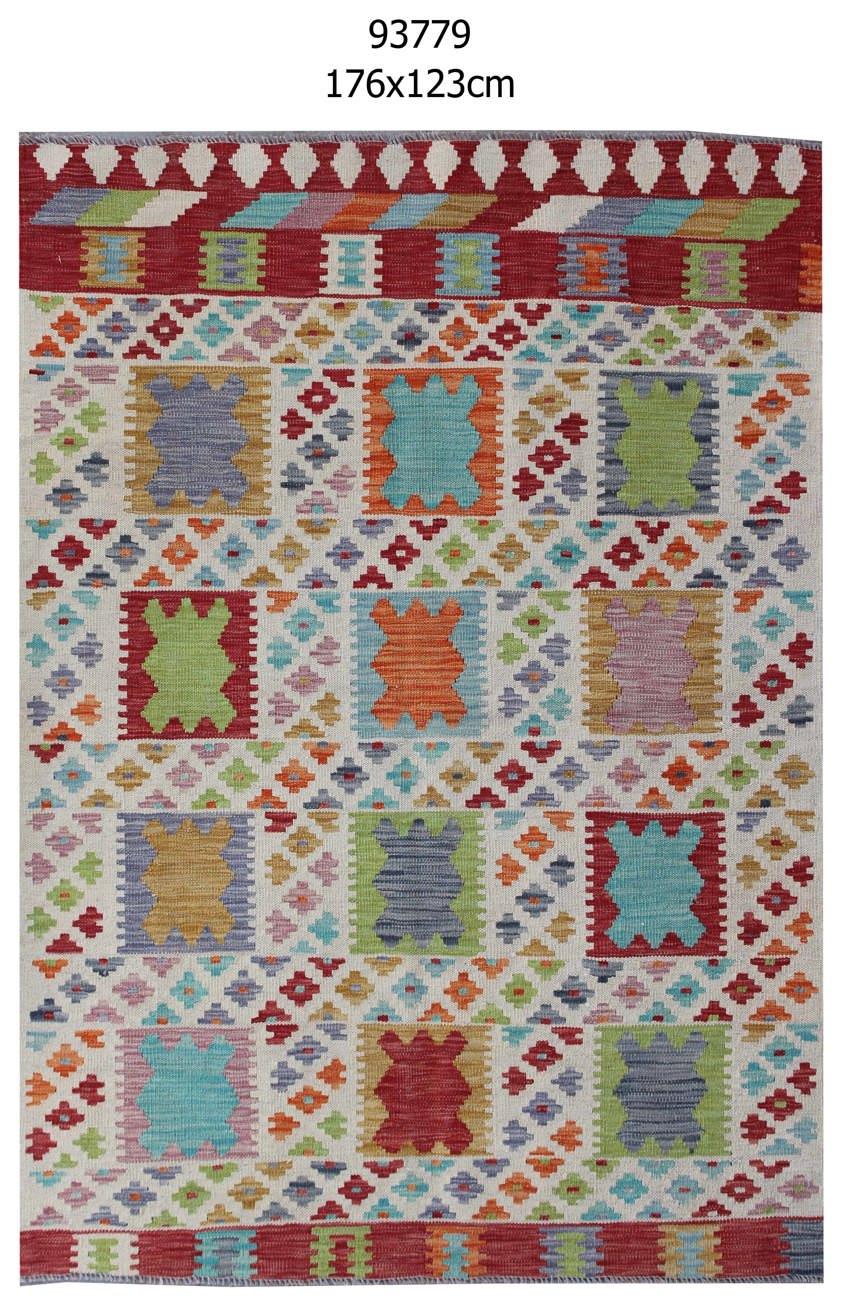
Twelve colourful square panels give this Afghan kilim rug an orderly patchwork structure. Each contains a compact stepped centre, with blue, green, orange, turquoise, grey and purple changing across the grid. Pale dividers are filled with small angular marks, creating a finer pattern between the larger blocks. Deep red end bands introduce narrow multicoloured details and a row of light shapes. Fine horizontal colour changes remain visible inside the panels. Their consistent format keeps the field coherent, while the varied centres prevent the repeated squares from becoming visually identical.
A compartmented field makes full use of repetition within kilim flatweaving. Coloured wefts interlace with the warp to create a flat textile without a layer of knotted pile. Boundaries between colour areas can become a framework around smaller internal motifs. Afghan kilims use this relationship between division and detail to organise varied palettes, allowing each compartment to have its own emphasis within a readable overall plan.
This rug would suit an informal sitting space with plain cream fabrics and natural wood. Accessories could echo a few selected panels rather than introduce another complex pattern. The distributed grid would remain effective around an open table, even where some squares are partly covered. Keeping the red ends exposed would retain the change of rhythm beyond the patchwork field. Quiet walls would make the small divider marks easier to appreciate nearby.