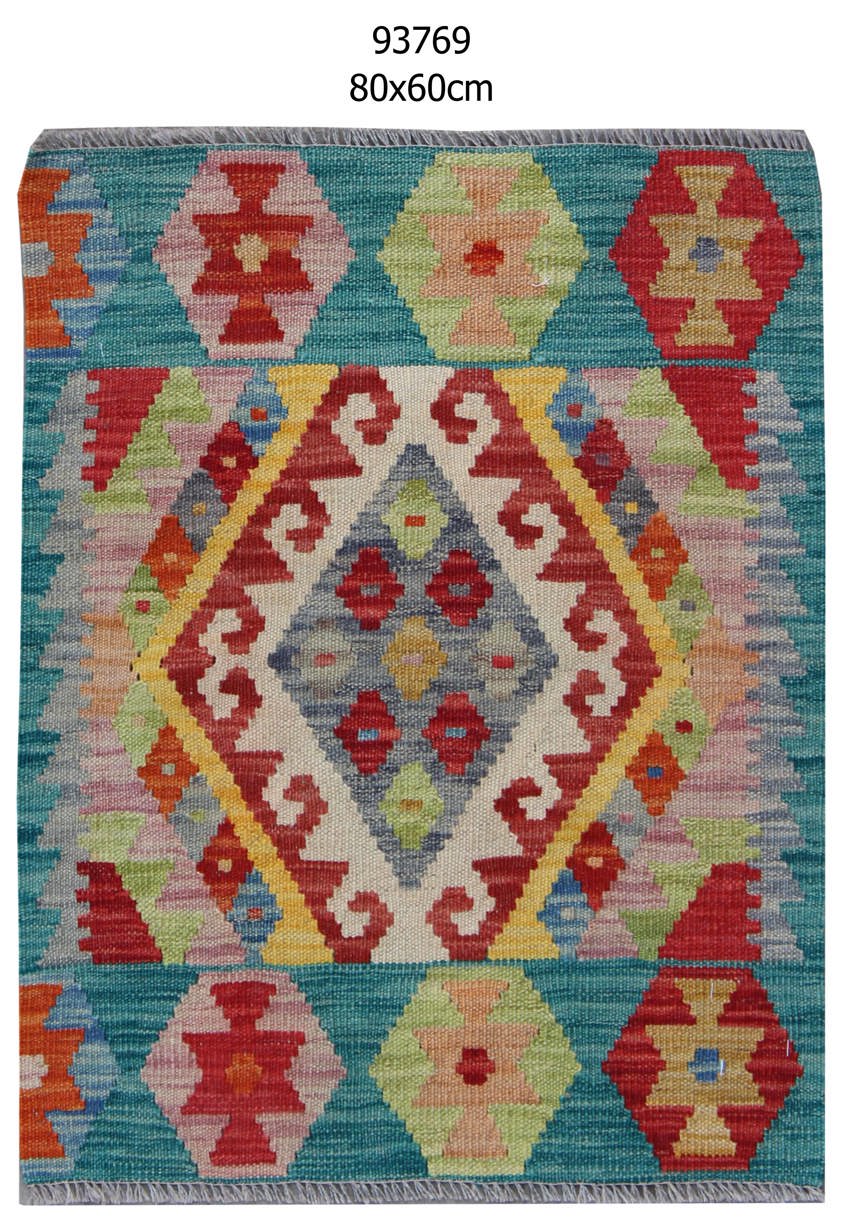
A colourful central diamond fills much of this small Afghan kilim rug. Red hooked bands turn around blue, yellow and cream inner areas, with small coloured figures grouped inside the centre. Turquoise end panels contain broader repeated units in red, lime and cream. These strongly marked ends give the compact composition a clear beginning and finish around its single dominant medallion. The centre is denser than the surrounding panels, offering many small details within a relatively broad enclosure. Cream keeps the red hooks distinct, and yellow introduces a warmer interval beside the blue.
Fine horizontal shading remains visible through the turquoise. The larger end figures repeat related angular shapes at a slower scale, preventing the central detail from extending uniformly across the whole surface. Kilim weaving creates a flat patterned textile through the interlacing of coloured wefts and warp threads. It has no knotted pile. Nested geometry allows several colour areas to build a single motif, while related units can be repeated more openly elsewhere.
Afghan kilims use this flexibility to combine a concentrated centre with contrasting panels, giving small furnishings a strong overall plan and varied local interest. This rug would work beside pale timber or a plain cream chair. Turquoise accessories could echo the ends, while a little red elsewhere would connect with the hooks. An uncovered position would preserve the central diamond. Quiet surrounding fabrics would let its many small internal figures remain legible at close range without competing with another pattern.