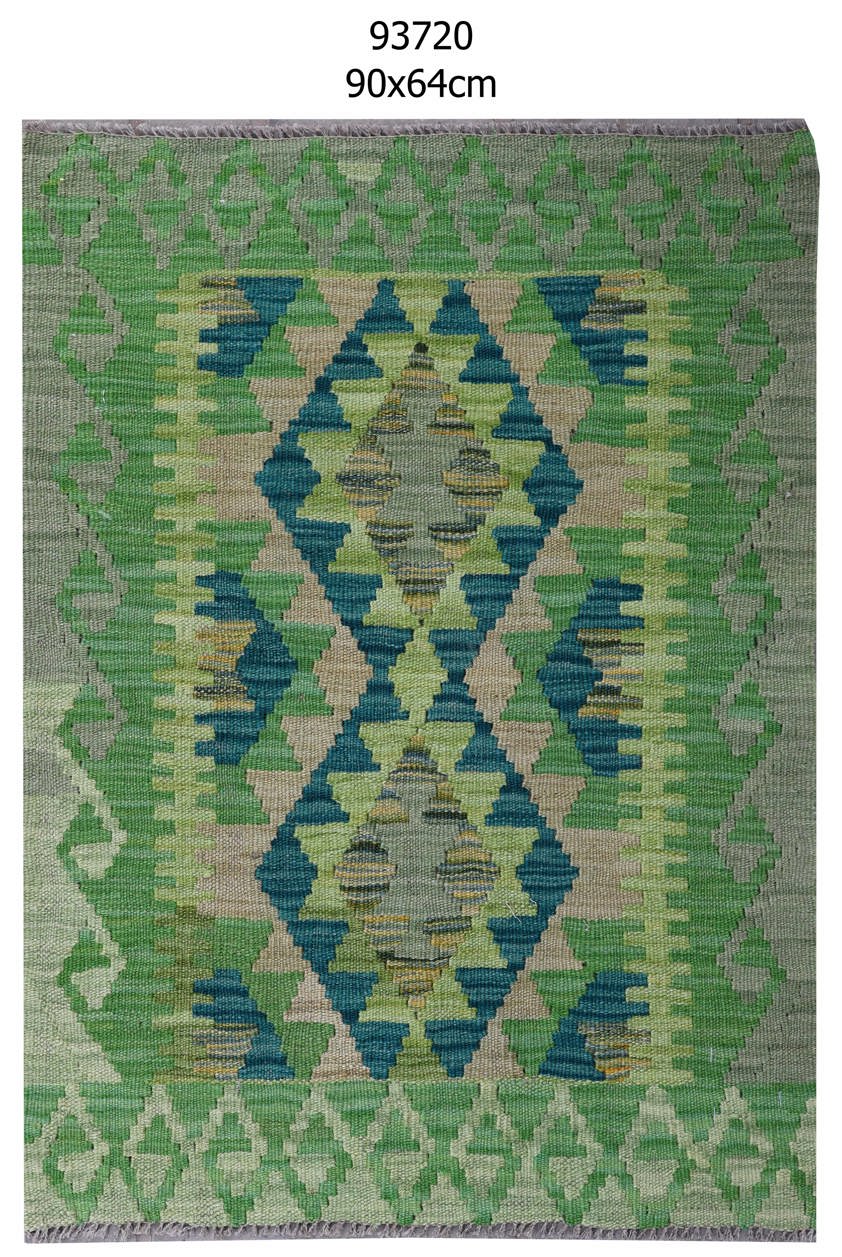
Deep blue bands surround two pale green and yellow centres on this Afghan kilim rug. Cream stepped outlines expand towards a softly shaded green field. Smaller green hooks and angular details run near the perimeter, creating a light enclosing rhythm. The central pair is elongated and closely joined, giving the compact composition a clear direction. Fine horizontal changes pass through the green and blue, adding visual depth to the flat surface. The darker internal bands provide more emphasis than the outer edge, keeping attention on the repeated central forms.
Kilim flatweaving constructs a patterned textile from coloured wefts interlaced with warp threads. It has no knotted pile. Nested bands follow the meeting of adjoining colour areas, allowing repeated geometry to remain clear even where some shades are close in tone. Afghan kilims use this structure for both strong contrasts and gentler colour relationships, with darker outlines often providing the principal organisation within a softly varied field.
This rug would complement pale timber, linen and plain cream furniture. Blue ceramics could echo the inner bands, while green fabrics would continue the broader palette. Beside a bed or chair, an open position would retain both centres and the fine perimeter hooks. Quiet surrounding patterns would give the shaded green passages room to register, bringing colour into the space without relying on a busy border.