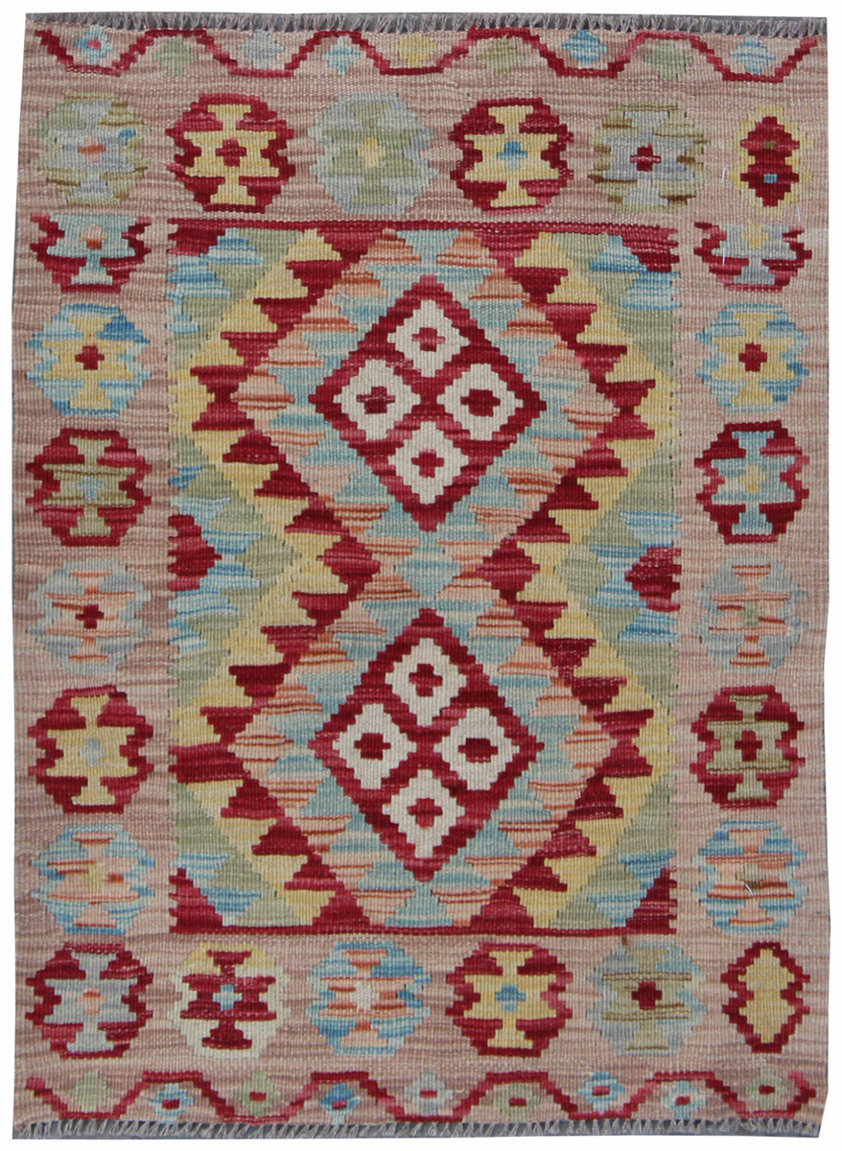
Fourfold red figures sit inside two pale blue medallions on this Afghan kilim rug. Their small light centres are joined by a red cross-like structure, while cream and yellow bands surround the larger forms. Separate roundels and compact geometric emblems occupy the sides and ends. The background is light, with soft blue and warm neutral shading. A narrow red line curves along the perimeter, providing enclosure without the weight of a broad border.
Fine horizontal changes give the pale field texture and keep the smaller coloured details distinct. Kilim construction forms pattern through coloured wefts interlaced with warp threads. It creates a flat textile without knotted pile. Repeated stepped units can be organised into a large medallion or reduced into small surrounding motifs. Afghan kilims use these changes of scale to establish a hierarchy across the surface, connecting a dominant central pair with lighter, more widely spaced figures while retaining a shared geometric vocabulary. This rug could bring detailed colour beside a plain chair or pale timber bed.
Red accessories would connect with the central emblems, and blue-grey fabrics could echo the surrounding bands. Keeping both medallions visible would preserve their balance. Cream walls and simple furniture would give the varied outer roundels room to remain part of the design rather than disappear into a busier setting. The red outlines also link the smallest peripheral details.