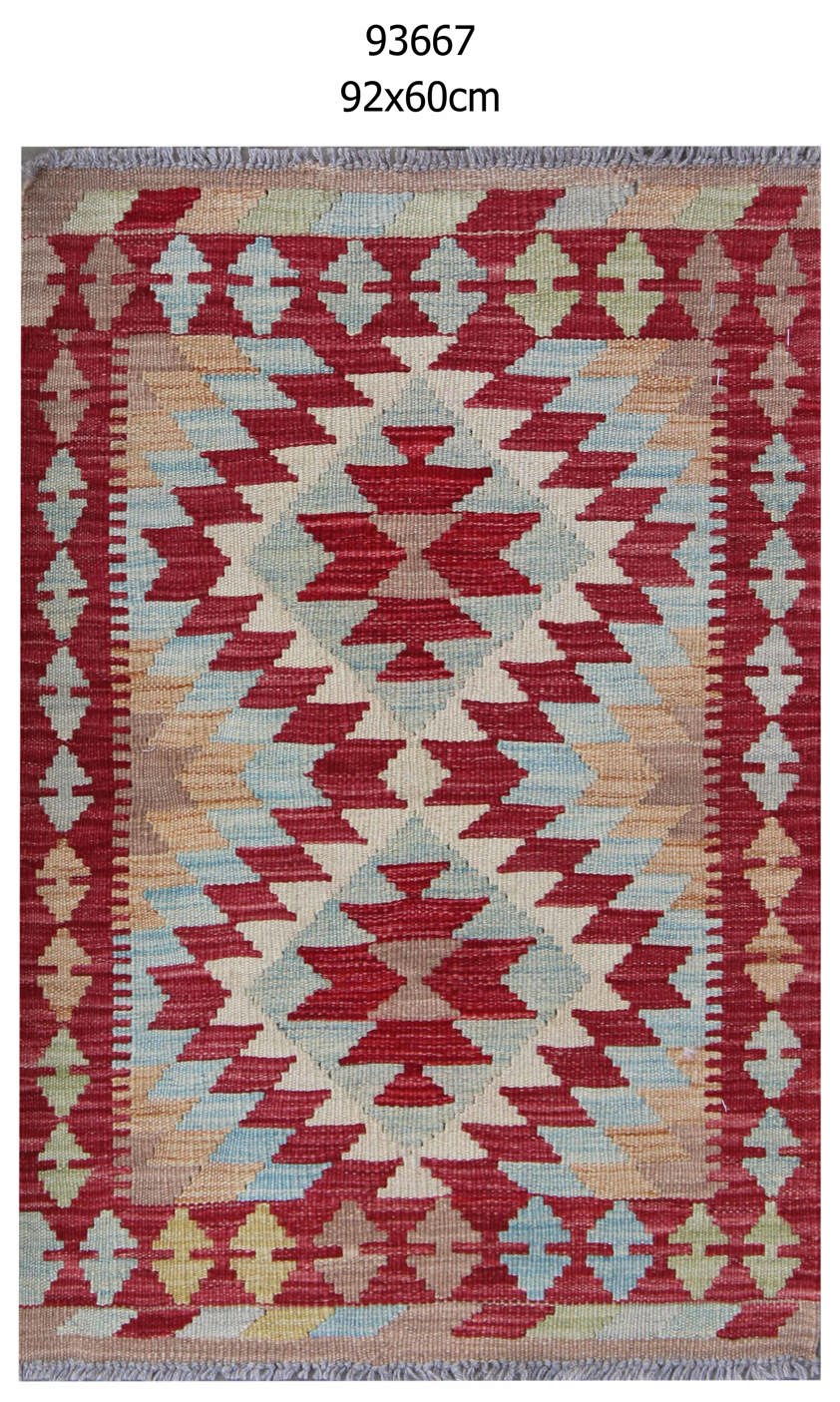
A burgundy zigzag chain runs through the centre of this Afghan kilim rug. Pale blue and cream bands widen around it, creating a series of pointed enclosures rather than separate round medallions. The surrounding field introduces softly shaded beige and light blue areas. Small angular figures repeat along the sides and ends, giving the continuous central movement a clearly marked perimeter. The design alternates narrow joining points with broader stepped sections. Burgundy remains the strongest structural colour, while the paler bands make its changing outline easy to follow. Fine horizontal variation is visible through the lighter areas.
At either end, compact rows of red and pale units provide a quicker rhythm, finishing the pattern without interrupting its overall direction. Kilim flatweaving can develop a composition from a continuous line as readily as from isolated motifs. Coloured wefts cross the warp to create pattern in a textile without knotted pile. Stepped and interlocking boundaries suit this construction, allowing adjacent colours to form connected bands. Afghan kilims use such repetition to organise a field, adjusting the width and scale of related elements as they move towards the edges.
This rug could bring a clear directional accent beside a bed or reading chair. Burgundy accessories would connect with the central chain, while cream fabrics and pale wood would continue its lighter setting. Keeping the middle largely uncovered would preserve the changing stepped outline. Plain surroundings would let the finer end details remain visible as a secondary layer of interest.