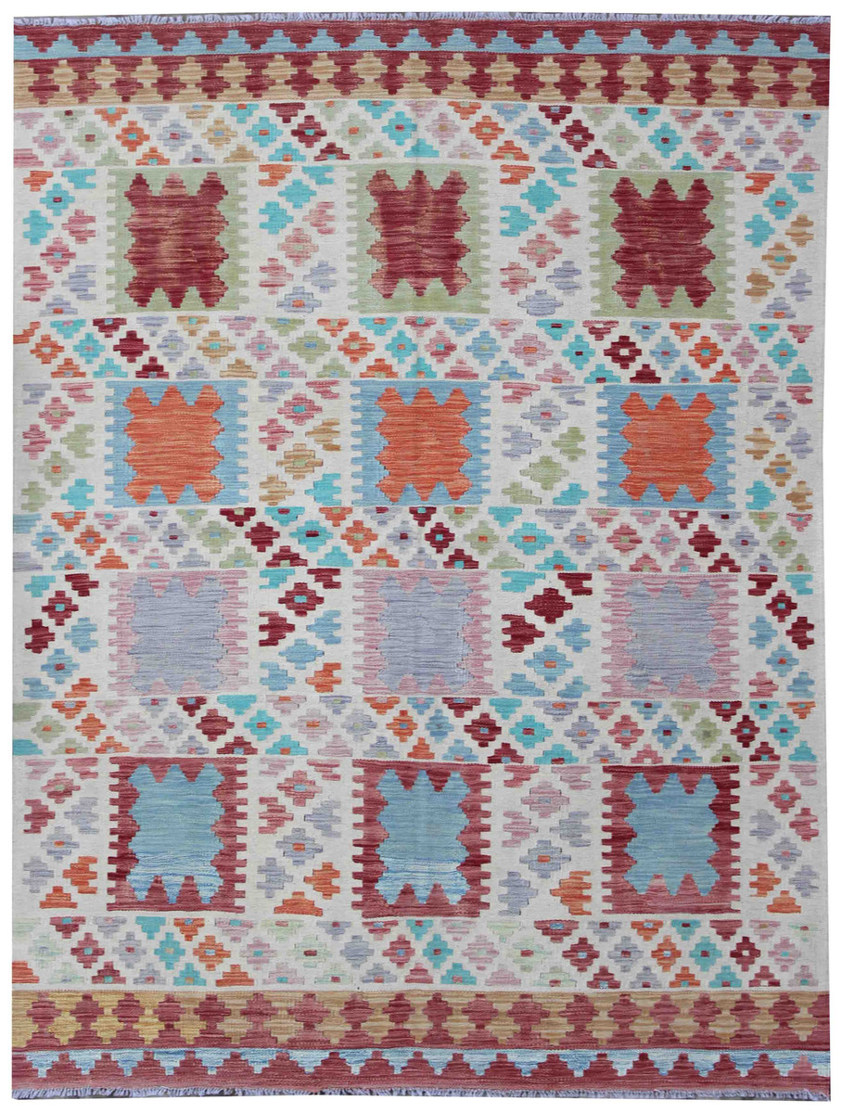
Square panels in soft blue, muted red, orange and pink form the centre of this Afghan kilim rug. Pale diagonal dividers carry smaller geometric motifs between the larger blocks. The squares have stepped edges, making their boundaries part of the pattern. Narrow bands at the ends introduce a more compact repeat and give the lighter central grid a clear finish. The internal colours vary from panel to panel. Some centres are pale and open, others stronger and more emphatic, producing a gentle alternation across the field. Fine horizontal tonal shifts add visual texture within the flat surface. The diagonal fillers bring movement through the otherwise regular grid. Repeated colours connect the end bands with the central panels, keeping the composition coherent despite its many separate units.
Kilims are made by flatweaving coloured wefts through warp threads. Pattern forms within the textile, without the raised knots of a pile carpet. Stepped outlines and repeated geometric compartments respond closely to this construction. Afghan furnishings include many ways of arranging such panels, with changes of internal colour allowing a simple framework to support a much more varied surface.
This rug would suit plain seating, natural wood and softly painted walls. Pale blue accessories could connect with the cooler panels, while muted red or orange details would echo the warmer ones. A simple table with open legs would leave several squares visible. The distributed pattern remains decorative around furniture, making the rug adaptable within a bedroom or informal sitting area that needs colour without additional strongly patterned fabrics.