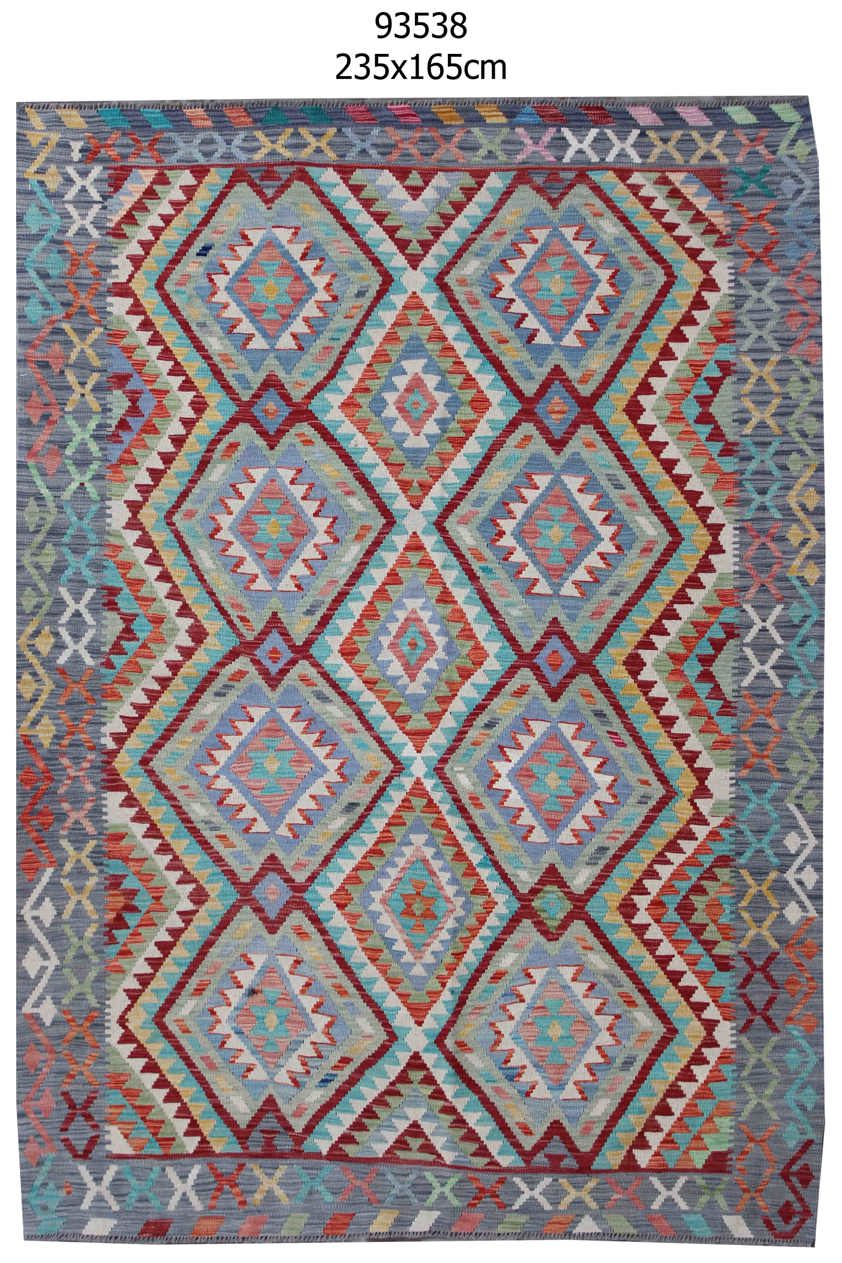
Large blue diamonds fill the central panel of this Afghan kilim rug. Red outlines and cream stepped bands define their edges, with smaller multicoloured centres adding variation. A darker surrounding field carries angular motifs in a finer repeat. Narrow end bands continue the same palette, creating a clearly layered composition with a strong distinction between larger internal forms and closer edge details. The red gives the blue shapes definition without becoming the main ground colour. Cream adds light, and fine horizontal tonal changes give the flat surface depth.
Some centres are warmer, others cooler, keeping the repeated diamond arrangement lively. The darker sides provide a firm frame, while their smaller motifs remain connected to the centre through shared colours and stepped outlines. Flatweaving creates the surface of a kilim through coloured weft threads interlacing with warp threads. There is no knotted pile in this construction. Nested angular shapes and stepped boundaries are particularly suited to the method.
Afghan kilims use a broad range of such geometric arrangements, often combining larger organising forms with smaller repeats to give a textile interest at different scales. This rug could anchor a smaller sitting group with plain upholstery. Pale blue accessories would echo the field, while a red detail in artwork or cushions would reference the outlining. Natural wood would balance the cooler palette. An open-legged table would preserve more of the nested centres, and the darker frame would continue to provide definition around furniture on a lighter surrounding floor.