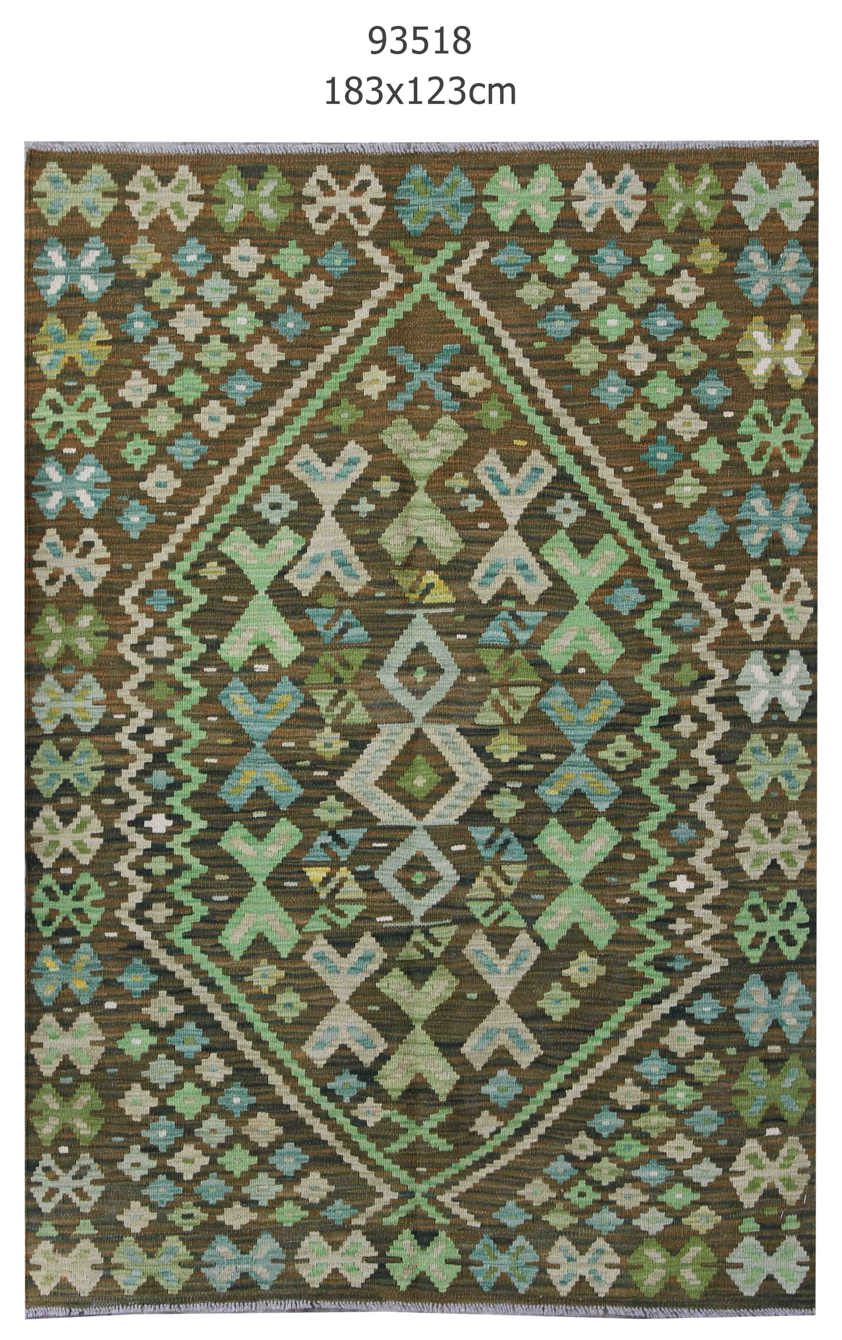
A large diamond enclosure organises the olive field of this Afghan kilim rug. Pale angular emblems are arranged inside it, with blue-green and muted yellow details adding variation. Small repeated motifs fill the surrounding corners and edge areas. The composition is clearly centred, but the closely worked outer field gives the whole surface a continuous decorative character. The natural palette has considerable depth. Fine horizontal shifts of green, olive and darker shades are visible within the flatweave, softening the pale outlines.
Some internal emblems are more strongly defined than others, allowing the larger enclosure to remain the main structure. The small outer repeat introduces a quicker rhythm. In kilim weaving, coloured weft threads cross the warp to form the textile and its visible design. This flatwoven method differs from knotted pile construction. Repeated angular units and stepped boundaries are closely suited to it, providing a versatile vocabulary for the varied geometric furnishings associated with Afghan weaving traditions. This rug could work with timber furniture, cream upholstery and muted green walls.
Blue-green accessories would pick up the cooler details, while pale fabrics would echo the outlining. Leaving a substantial part of the central diamond visible would preserve the balance between its larger emblems and the finer surrounding repeat. An open-legged table would allow that relationship to remain apparent. The restrained colours could bring detailed pattern to a bedroom or smaller sitting room without requiring bright accents on other surfaces.