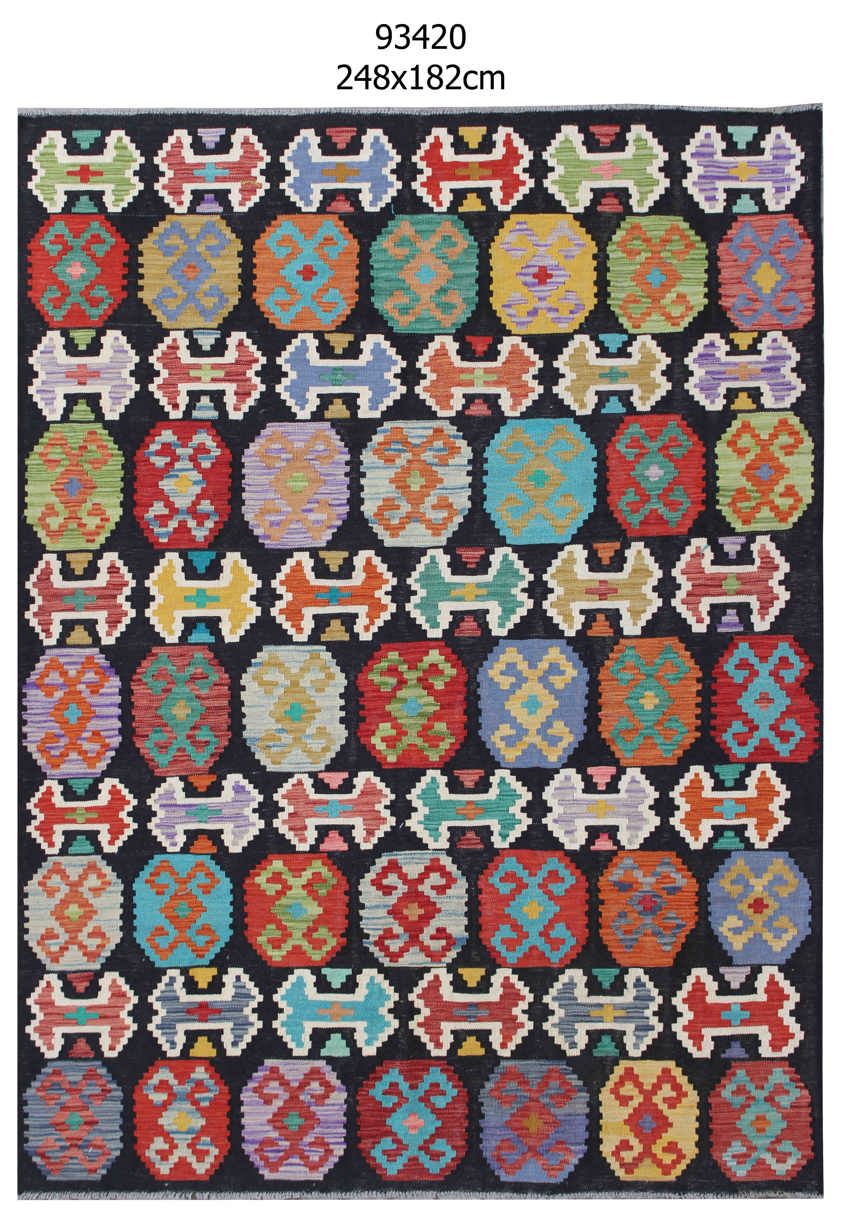
Rows of bright geometric units fill the black field of this Afghan kilim rug. Their rounded, stepped outlines contain contrasting internal emblems in turquoise, red, yellow, purple, green and cream. Between the coloured rows, pale angular forms create a separate rhythm. The design is regular enough to read clearly, but its changing colour combinations make the surface lively and varied. The dark background acts as a framework for the brighter motifs. Each unit remains distinct, and the pale dividers provide pauses between the densely coloured sections. Fine horizontal tonal changes add visual texture within the flatweave. Some centres are strongly contrasting, while others combine more closely related shades.
The pattern reaches almost to the edge, with a relatively quiet perimeter keeping attention on the repeated field. In kilim weaving, coloured wefts interlace with warp threads to create a flat patterned textile. This differs from construction with knotted pile. Repeated angular units and stepped boundaries are closely suited to the method. Afghan kilims include a broad range of geometric arrangements, with a stable repeat allowing considerable variation in the colours and smaller motifs used inside each form.
This rug would make a lively foundation for a sitting room with plain fabrics. Cream upholstery could echo the pale dividers, while dark wood would connect with the background. Choosing a few accent colours for cushions or artwork would keep the room coherent. Its all-over pattern remains decorative around a table, since the visible sections continue the same colourful rhythm throughout the field.