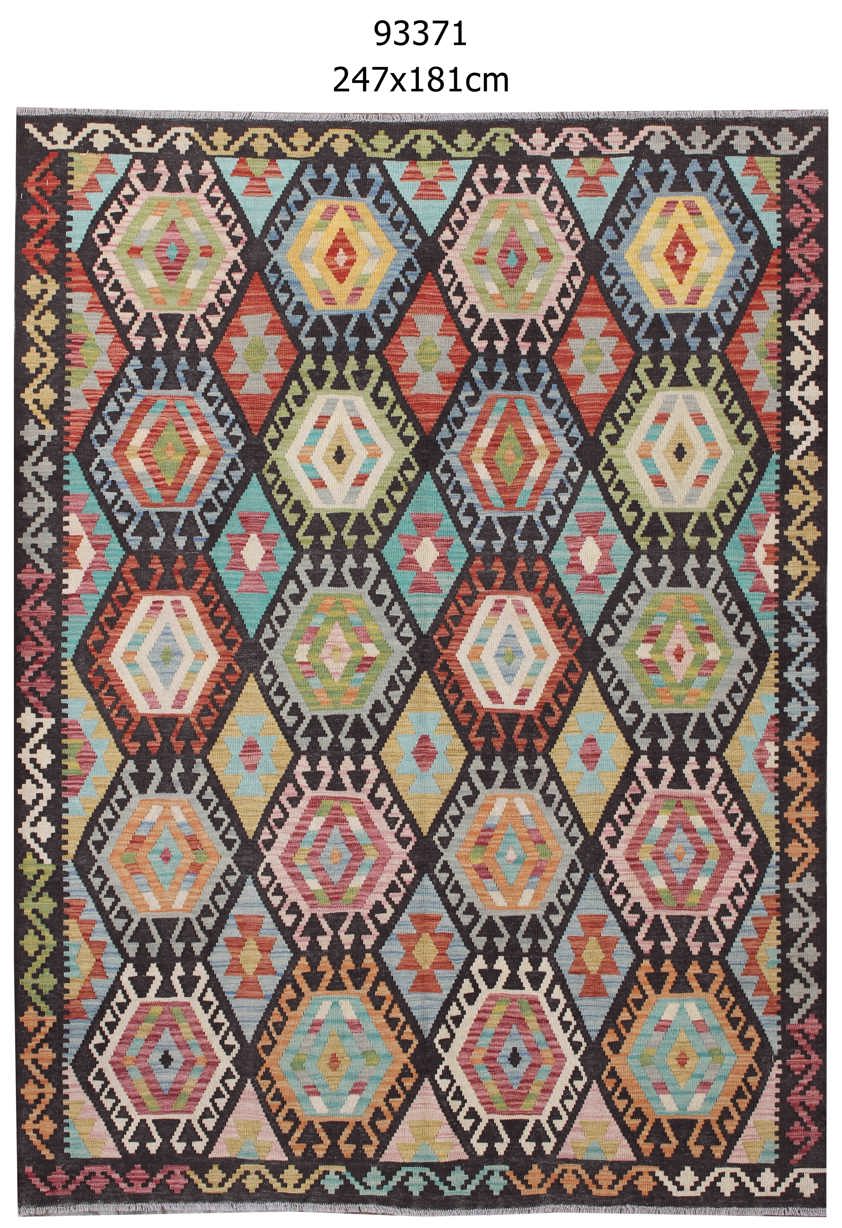
Cream-edged hexagons form an ordered grid over the black field of this Afghan kilim rug. Their centres change between pale blue, pink, green, ochre and warmer red accents, with smaller nested diamonds adding depth. Angular links fill the gaps between the larger units. A narrow multicoloured border encloses the repeat, continuing the geometric language at a smaller scale. The dark ground is largely a framework for the coloured forms. Pale outlines keep them separate, and the changing internal palettes prevent the regular grid from feeling uniform. Fine horizontal tonal variation adds visual texture within the flat surface.
The broad hexagons register clearly across a room, while their smaller divisions become more apparent nearby. This gives the rug interest at several viewing distances. Flatweaving creates the patterned surface of a kilim through interlaced warp threads and coloured wefts. Unlike a knotted pile carpet, the design is carried within the textile structure. Stepped boundaries and nested angular shapes respond closely to this method. Afghan kilims encompass many forms of geometric repetition, with a consistent outline allowing considerable freedom in the colours used inside each unit.
This rug would suit a sitting room with plain sofas and natural timber. Cream upholstery could echo the outlines, while a few accessories might reference selected centres. The all-over grid remains coherent around furniture, making it adaptable beneath an open-legged table. Quiet walls would provide a calm setting for the varied colours and allow the individual hexagons to remain clearly readable.