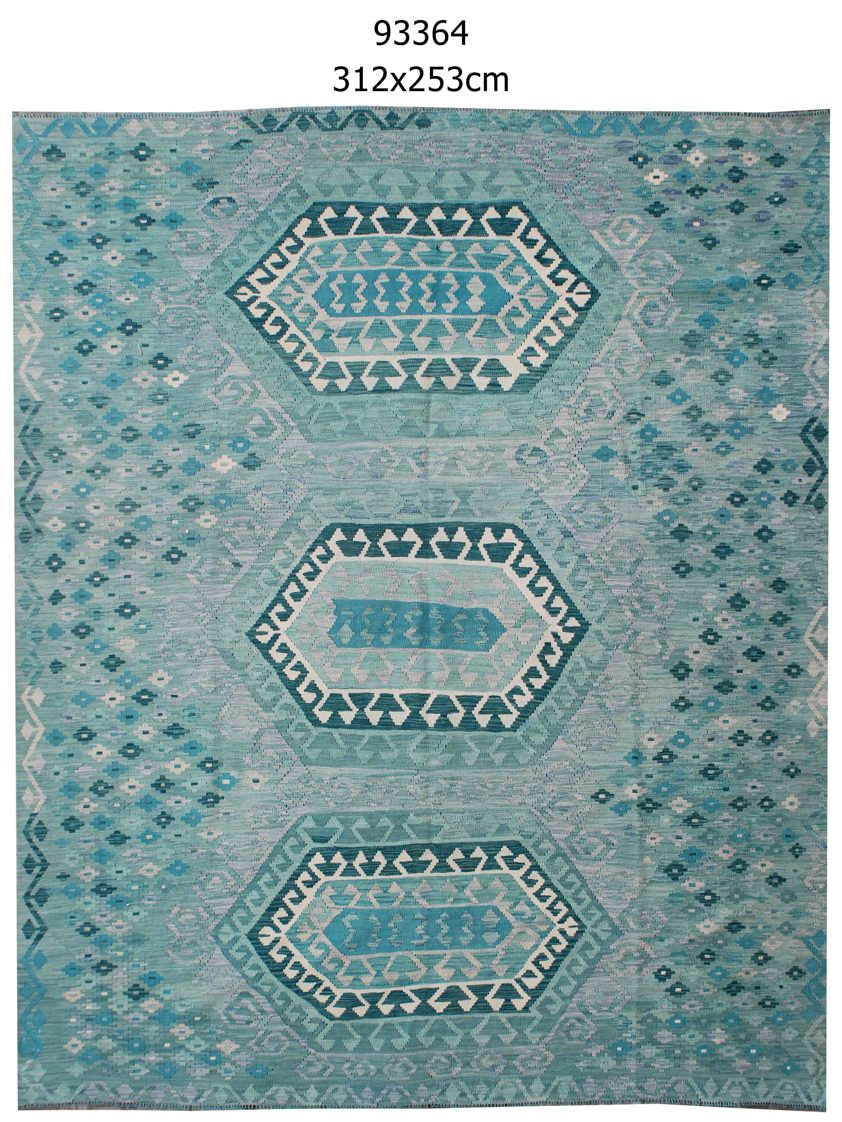
Three large hexagonal forms give this Afghan kilim rug a measured central sequence. Turquoise, pale blue and cream outlines surround smaller angular details, with the middle form more open than the two at the ends. The surrounding blue-green field is filled with tiny geometric marks. The composition is expansive but quiet in colour, with most contrasts occurring between closely related cool shades. Fine horizontal tonal variation adds depth across the flat surface. Some of the smaller motifs are darker and immediately visible, while others blend gently into the background. Pale outlining keeps the principal hexagons legible without making them sharply separate from the field.
In kilim weaving, coloured wefts interlace with the warp to create a flat textile and its design. There is no knotted pile in this construction. Angular boundaries and repeated geometric units respond closely to the method, allowing large medallions to sit within finely patterned grounds in many Afghan furnishing designs. This rug could create a calm foundation for a generous sitting area with pale upholstery and natural wood.
Turquoise accessories would echo the principal forms, while darker blue details could draw out the smaller marks. Its distributed pattern would remain useful where furniture covers part of the field. A relatively open central arrangement would preserve the relationship between the three large hexagons, allowing their quieter internal differences to be appreciated across the room as well as nearby.