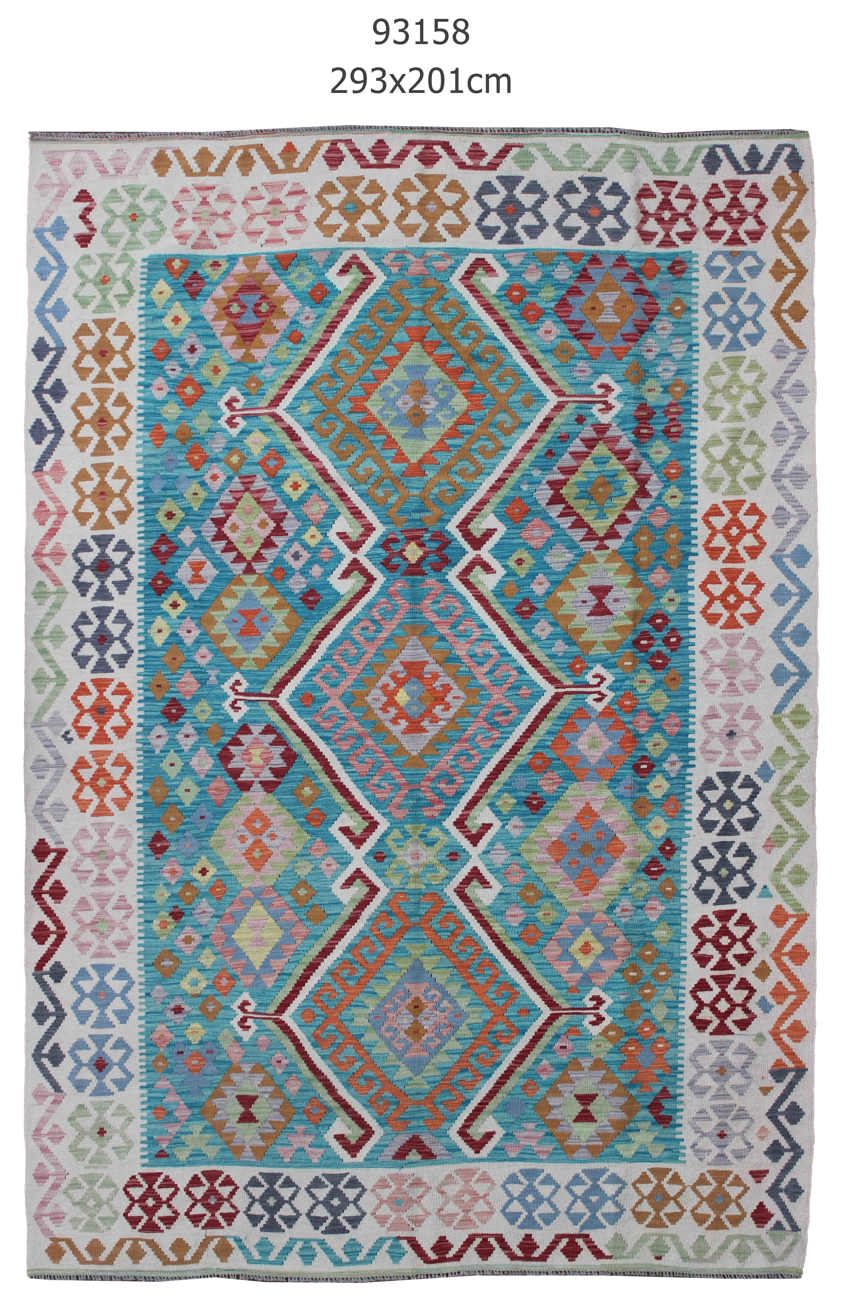
Turquoise runs through the centre of this Afghan kilim rug, providing a clear setting for a chain of large stepped diamonds. Smaller lozenges and geometric details fill the spaces on either side. Coral, ochre, cream and softer blue accents appear within the motifs, making the central colour feel varied rather than uniform. Pale outer borders lighten the composition and separate it from the floor. The large diamonds are connected vertically, giving the design a pronounced sense of direction. Their angular outlines are repeated in the small surrounding shapes, so the pattern remains coherent at different scales.
Changes of shade across the flat surface contribute to its visual character. The border has a looser sequence of coloured geometric forms, providing an effective contrast to the more tightly organised central chain. In a kilim, pattern is created through flatweaving rather than rows of pile knots. Coloured weft threads interlace with the warp to make both the textile and its visible ornament. Stepped diamonds and angular boundaries are particularly suited to this method.
Afghanistan's textile traditions encompass both flatwoven and knotted furnishings, and the geometric kilim represents one part of that varied heritage. For a room with pale walls, this rug would introduce colour without needing a strongly patterned companion fabric. The turquoise could connect to painted joinery, artwork or a single upholstered piece. Warm wood and muted terracotta would draw out the smaller accents, while the pale border would help maintain a light transition around the edge of the seating area.