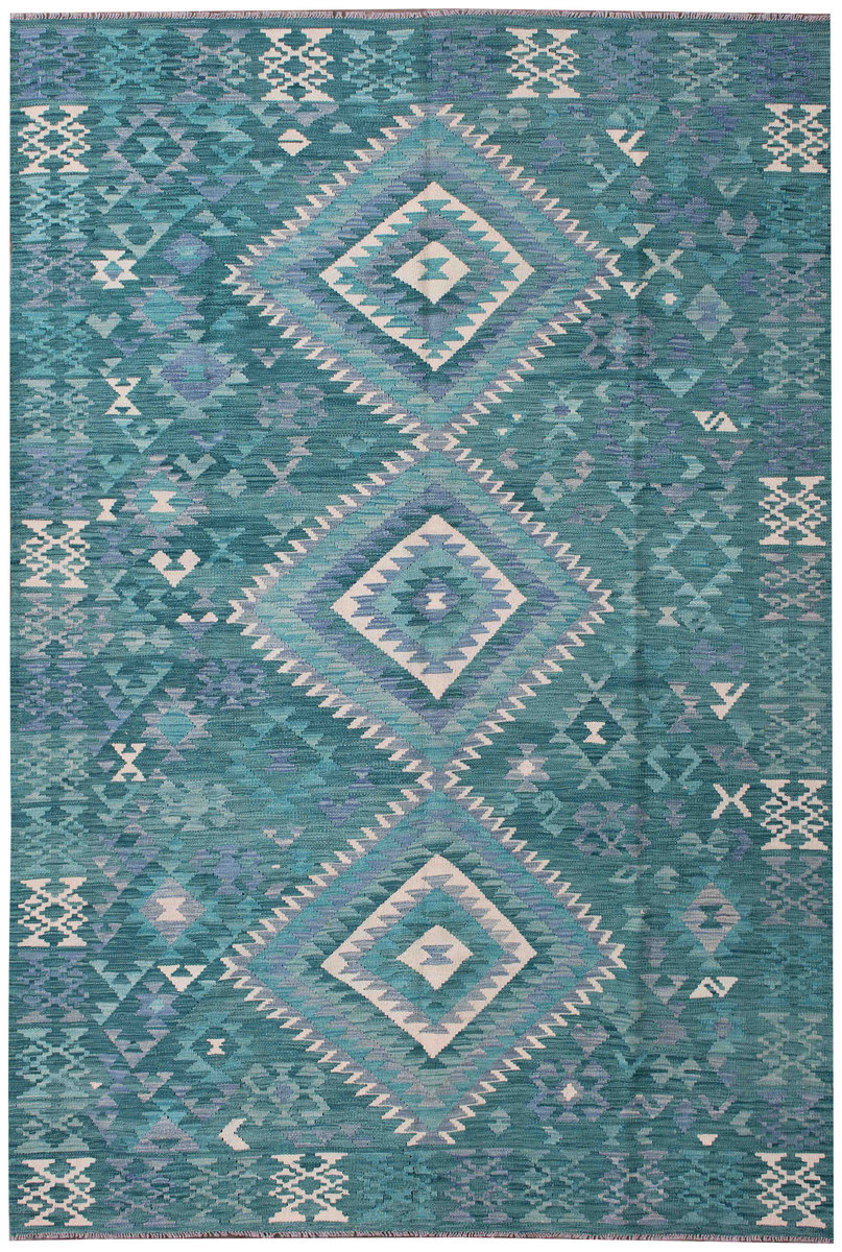
Three large diamonds run through the centre of this Afghan kilim rug, outlined in ivory against a richly varied turquoise ground. Their nested forms contain softer blue and pale cream details, while small angular figures spread across the surrounding field. At the ends, groups of compact geometric motifs provide a lighter boundary without interrupting the long central sequence. The substantial 304 × 202 cm format gives the design room to develop. Each diamond remains distinct, yet the pointed ends create a strong connection along the length.
The background shifts between teal, turquoise and quieter grey-blue tones, producing a finely textured visual effect. Pale scattered motifs are deliberately smaller than the central figures, so they enrich the field while preserving the hierarchy of the composition. Geometric floor coverings form part of Afghanistan's wider history of domestic textiles, alongside patterned bags and other useful woven objects. Kilim is a broad flatweave category, with lozenges and stepped outlines recurring across many neighbouring traditions. This context helps explain the direct angular vocabulary of the rug without assigning a specific weaving community or a fixed meaning to its motifs.
The individual colour relationships and three-part arrangement come from the photographed piece itself. This rug could anchor a sitting room or bring a coherent band of colour beneath a larger furniture arrangement. Cream upholstery would echo the diamond outlines, while oak and walnut could balance the cool turquoise. Keeping the central axis visible would allow the three medallions to establish a clear rhythm through the room.