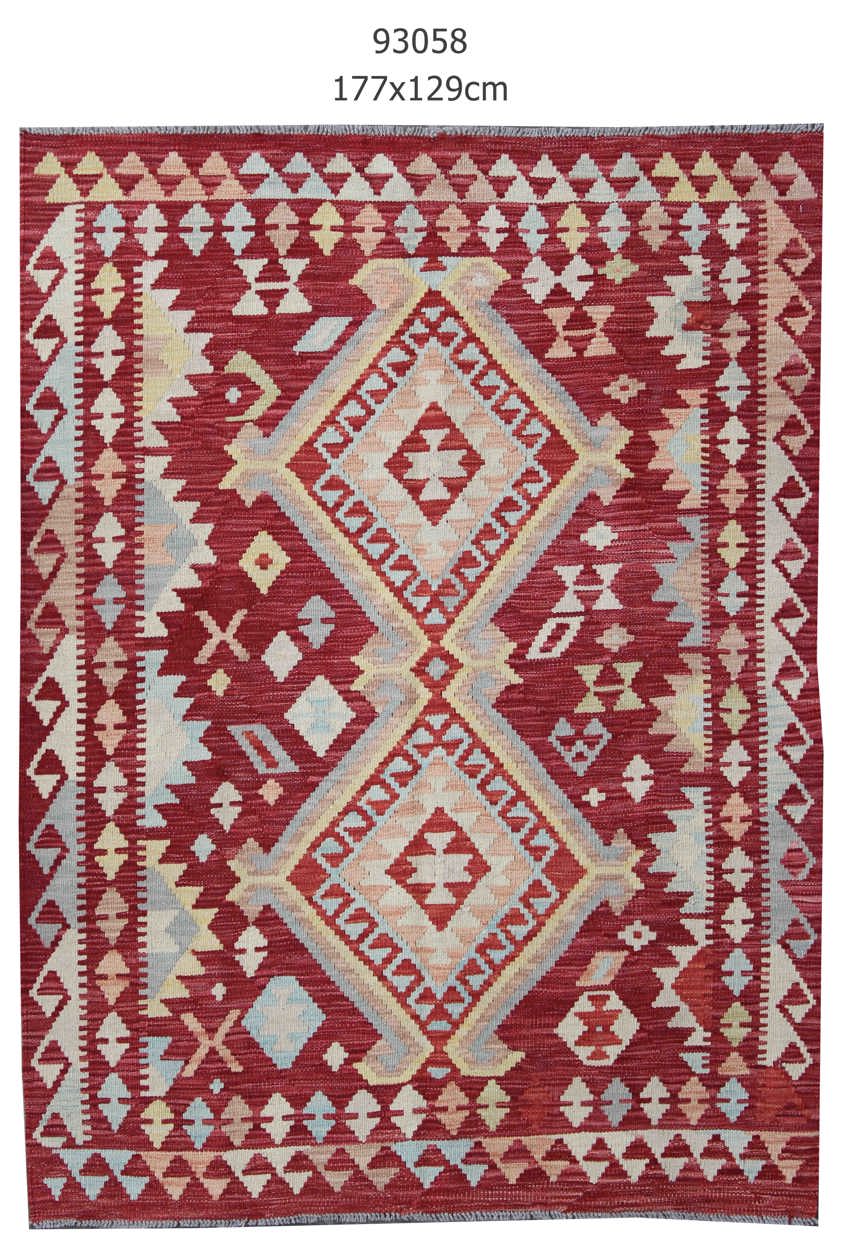
Crimson and cream establish the bold character of this rug. Two large diamonds run down the centre, their pale stepped outlines widening into strong zigzags against the red ground. Smaller lozenges and angular marks fill the spaces to either side, while a narrow sequence of triangles finishes the perimeter. Pale blue details appear within the principal motifs and along selected outlines. The design has a clear vertical energy, but the projecting edges of the diamonds also pull the eye out towards the sides. This interplay makes the pattern feel expansive within its compact rectangle.
Cream is used generously enough to break up the red, with softer beige and blue areas providing intermediate tones. Fine horizontal changes across the surface lend a less uniform appearance to the larger colour passages. Geometric rugs sit within Afghanistan's wider tradition of domestic woven furnishings. Kilims are part of the flatweave family, whose decorative language includes repeated lozenges, stepped forms and compact angular figures. Related designs occur across many textile-producing regions, and the shapes themselves do not establish a specific local origin or fixed meaning.
The Afghan attribution here is therefore kept distinct from any more precise community identification. Measuring 177 × 129 cm, this rug would bring a clear focal point to a reading area or bedside setting. Its red could complement warm timber and leather, while cream walls or upholstery would echo the principal outlines. A small blue accent elsewhere in the room could pick up the quieter colour within the centre.