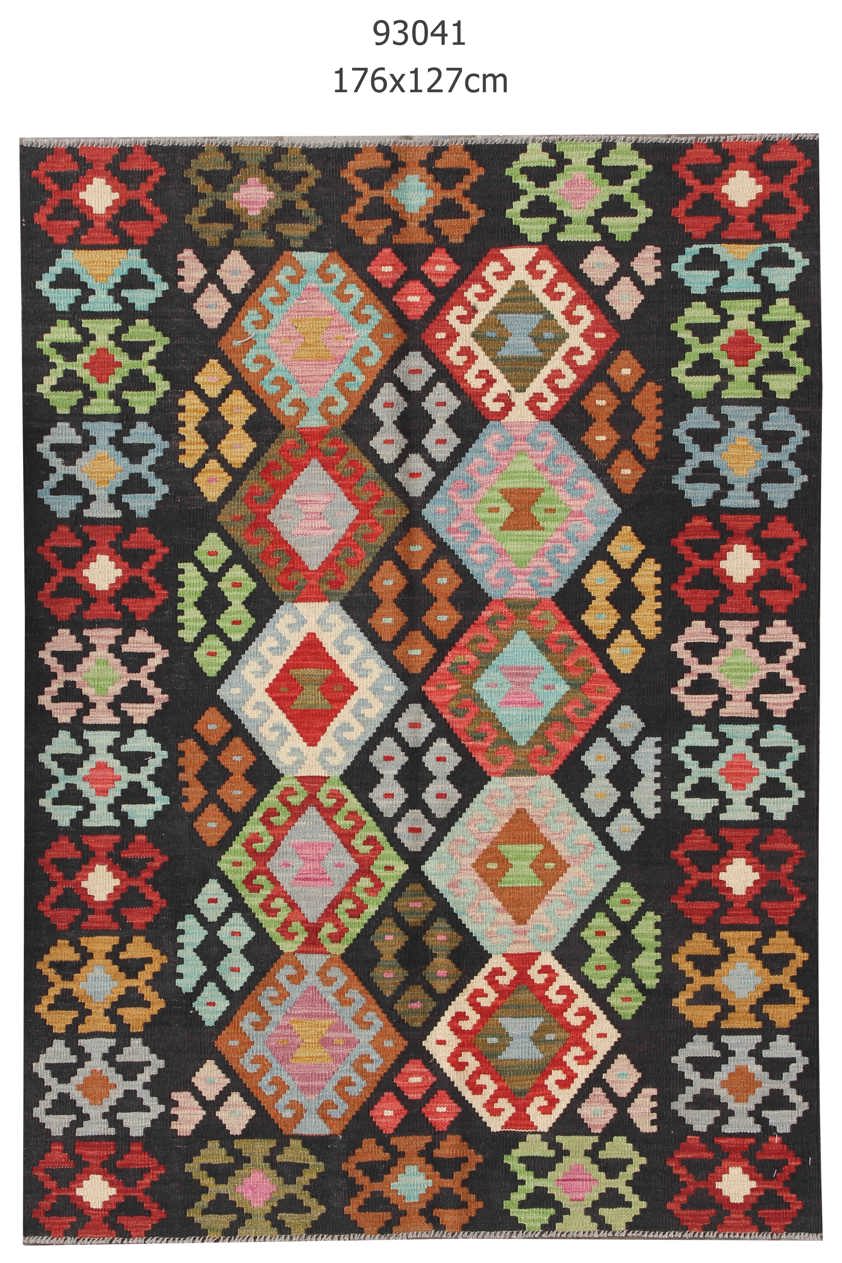
Bright colour stands out crisply against the black ground of this rug. Paired diamonds fill the central area in combinations of red, ivory, turquoise, pink and pale green, with hooked outlines adding movement to their edges. Smaller lozenges occupy the spaces between them, making the centre read as a closely connected geometric arrangement rather than a set of isolated medallions. Along the sides, stacked motifs change colour repeatedly, creating an energetic border that echoes the rhythm of the field. Warm orange sits beside cool blue, while pale cream gives the stronger colours room to breathe. The dark ground remains visible around every figure, holding the many shades together.
Despite the density of the pattern, the two-column structure makes the composition straightforward to follow. Afghan kilims belong to a broader tradition of domestic flatwoven furnishings, alongside patterned bags and other useful textiles. Repeated geometric figures are an important part of this visual heritage, with lozenges and stepped forms appearing in many arrangements. Similar shapes are shared across neighbouring textile cultures, so the design does not establish a particular tribal attribution.
This rug's character comes from its own strong colour contrasts and the way the motifs fill its rectangular format. At 176 × 127 cm, this rug could give a compact seating area a confident centre. Plain upholstery would allow the pattern to remain prominent, while a single red, turquoise or pink accessory could connect the floor to the wider room without repeating every colour.