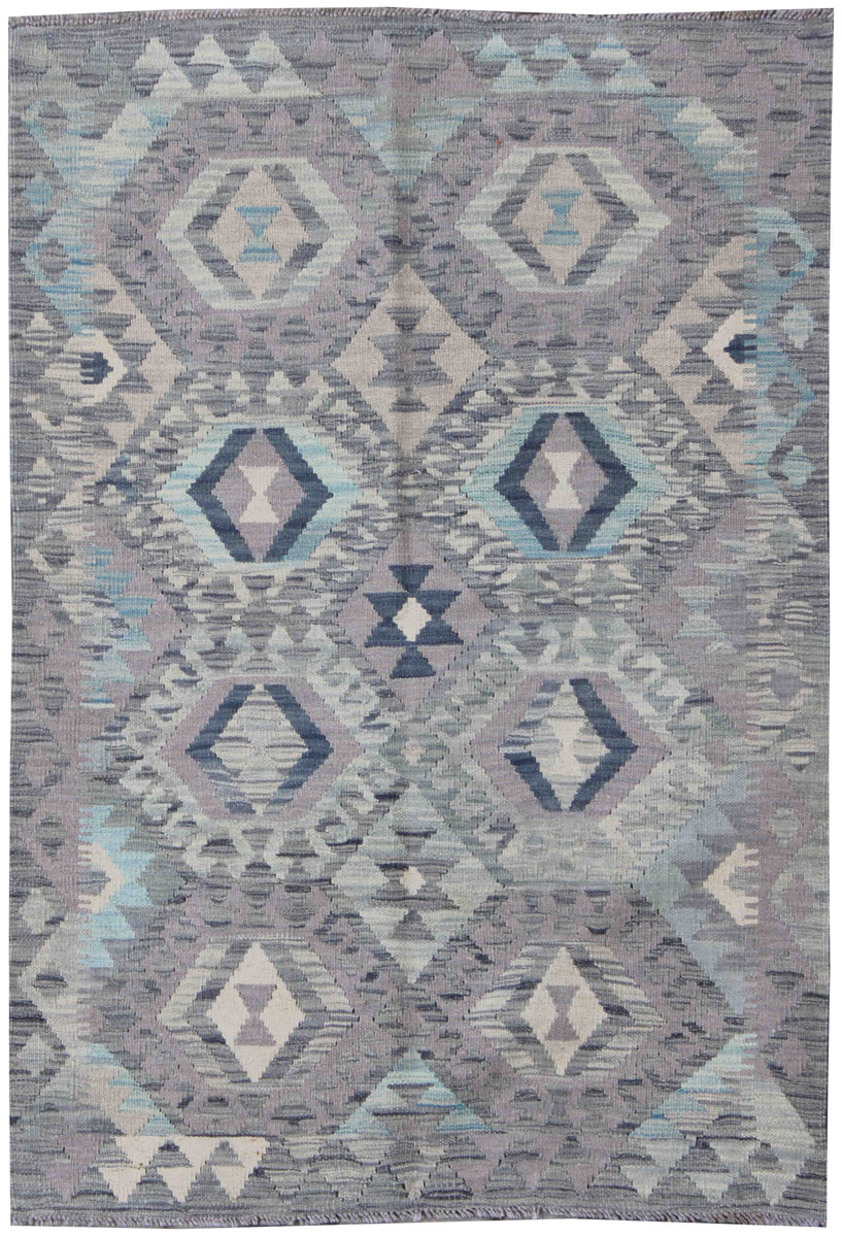
Slate grey and pale turquoise give this Afghan kilim rug a notably quiet interpretation of geometric pattern. Two columns of nested diamonds run through the field, their ivory outlines broken by darker centres and small angular details. Pale connecting lines create a larger diagonal framework, while triangular forms gather at the ends. The changing density of the grey ground keeps the composition from appearing rigid, introducing a softly striated background behind the clearly drawn motifs. There is a pleasing balance between the larger diamonds and the much smaller marks scattered around them. Some elements are strongly defined, while others sit close in tone to the ground.
This difference in emphasis allows the eye to move through the design gradually, rather than taking in every component at once. The photographed surface has a textile-like visual grain that complements the restrained colours. Kilim belongs to the broad family of flatwoven furnishings found across Afghanistan and neighbouring regions. Afghan domestic textiles have long included rugs, bags and other useful woven objects, with lozenges and angular repeats forming an important part of their decorative vocabulary.
That wider history provides context for this rug's geometry without assigning a particular community or symbolic meaning to its motifs. Measuring 152 × 102 cm, this rug would work beside a bed, beneath a small occasional table or as a defined accent in a study. Pale oak, charcoal upholstery and washed linen would draw out its gentle contrasts, while darker furniture could give the ivory outlines greater presence.