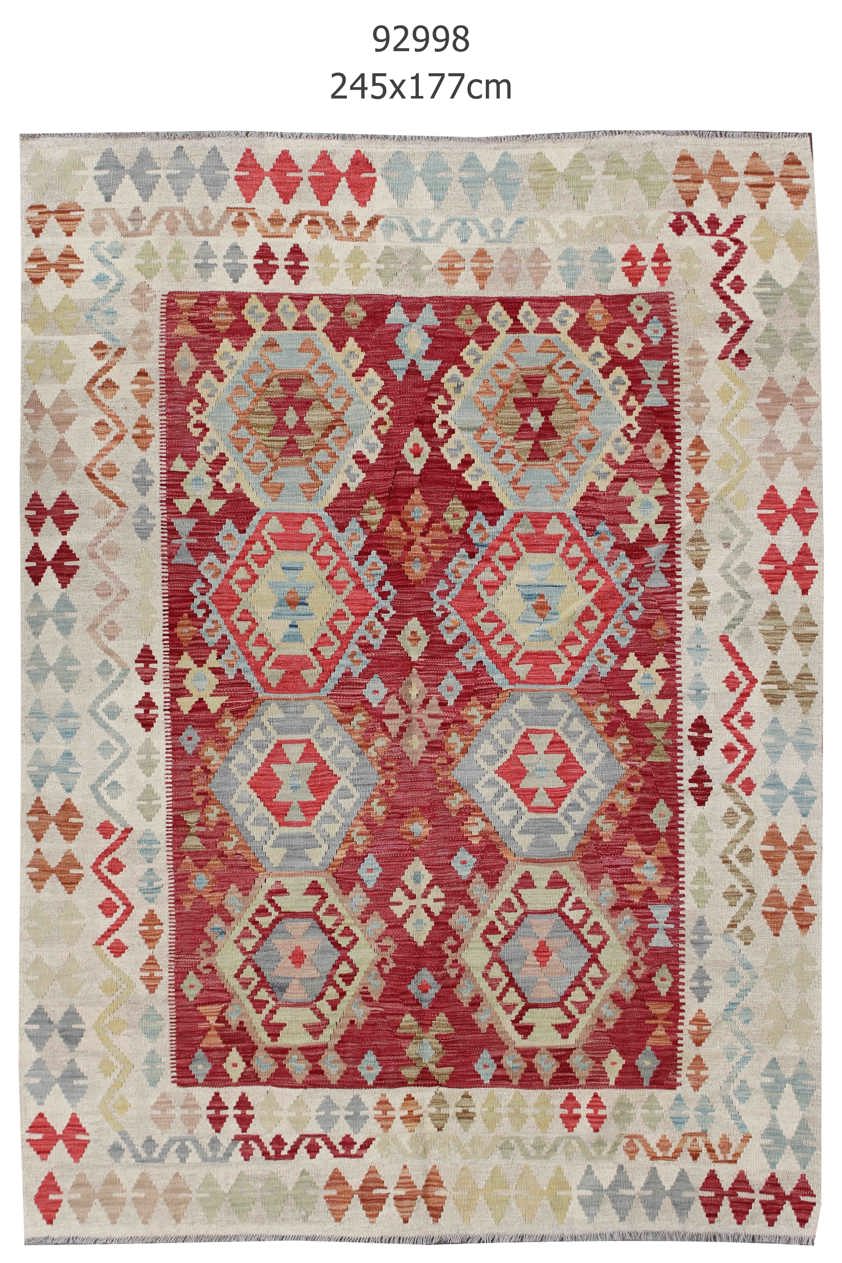
A wide cream border makes the red centre of this Afghan kilim rug feel especially distinct. Within the field, rows of pale angular medallions combine blue, green, ochre and cream. Each contains a small coloured heart, and their repeated stepped outlines create a closely connected geometric arrangement. The border introduces much smaller motifs, spaced more openly against its light ground. This change in density gives the rug a useful balance between a concentrated centre and a breathing margin.
Red returns in a few of the outer details, linking the frame to the field. Horizontal shifts across the pale medallions and the surrounding cream add visual softness to the precise drawing. Afghan flatwoven furnishings use geometric shapes in many configurations, from open fields to dense repeating patterns. A kilim's decoration is part of the fabric itself, giving the boundaries between colours a direct structural role in its appearance.
Here, the broad light frame highlights the difference between the larger central forms and the small motifs at the edge, showing how scale can organise a textile surface. At 245 by 177 cm, this rug could sit beneath a coffee table while leaving much of the cream border visible. Pale upholstery would connect with the frame, and red cushions or ochre ceramics could bring selected field colours into the room. Its balanced proportions would also work in a bedroom where the light perimeter remains visible around the furniture.