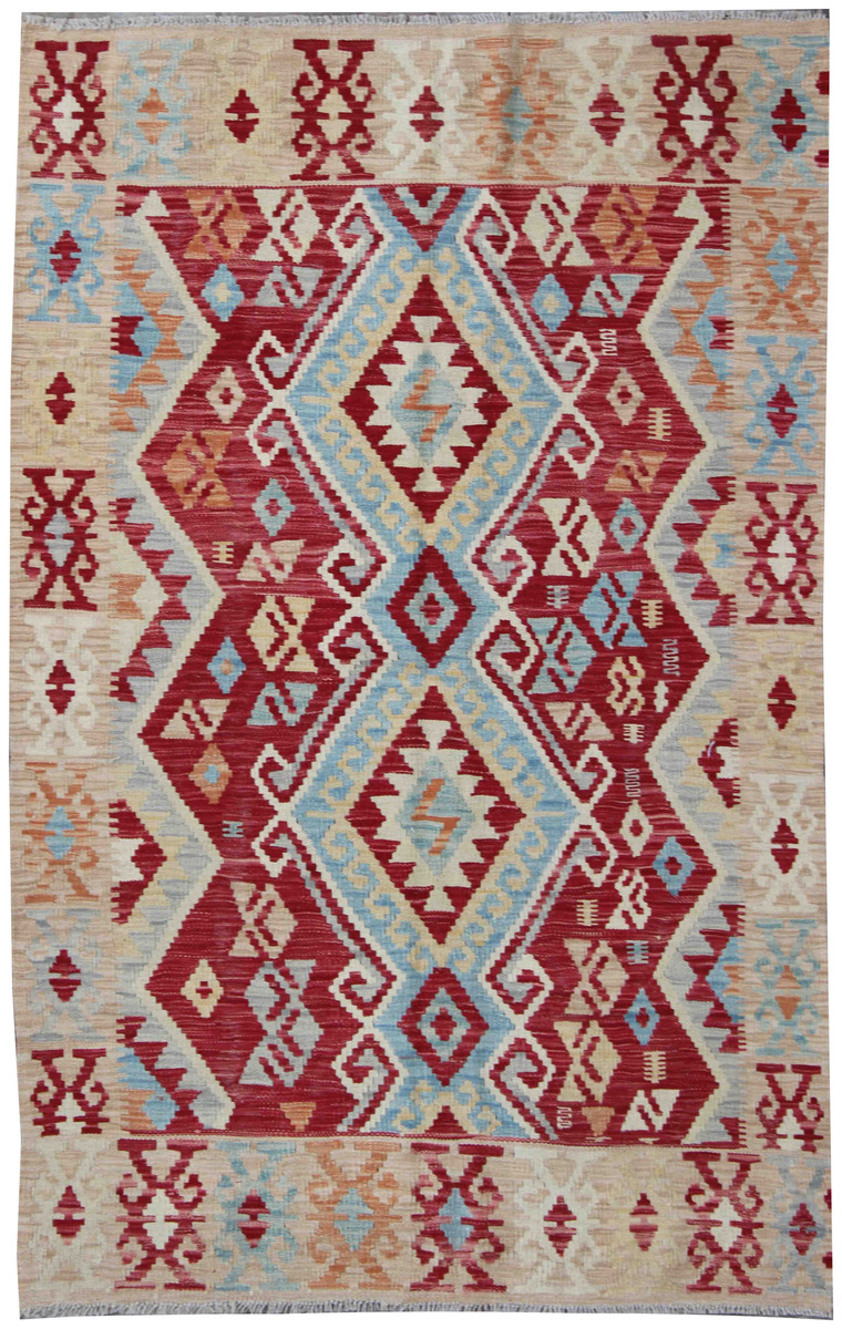
Burgundy zigzags create a strong central structure on this Afghan kilim rug. Pale blue diamonds sit within the darker field, their serrated edges enclosing cream and red centres. Smaller diamonds connect the main forms, and fine cream hooks articulate the transitions between them. The surrounding light border is comparatively open. Larger burgundy devices appear at intervals along the ends and sides, accompanied by smaller blue, ochre and red marks. This gives the rug a clear frame while preserving a relationship with the central geometry.
The contrast between dark red and pale blue is softened by the cream areas, which keep the design bright and legible. This rug would bring a defined pattern to a bedside position or a small seating area. It could work beside warm wood, cream fabric or painted furniture in a subdued blue. A visible edge around the furniture would show the open border, while leaving part of the linked centre uncovered would retain the directional quality of the design. Flatweaving gives geometric outlines a particularly direct role.
A kilim has no knotted pile, and the coloured woven areas make up both its fabric and its decoration. Afghan textile design includes many uses of repeated diamonds and stepped forms. Here, the relationship between a strongly coloured middle and a lighter frame gives those familiar elements a clear hierarchy, balancing the energy of the zigzags with quieter space around them.