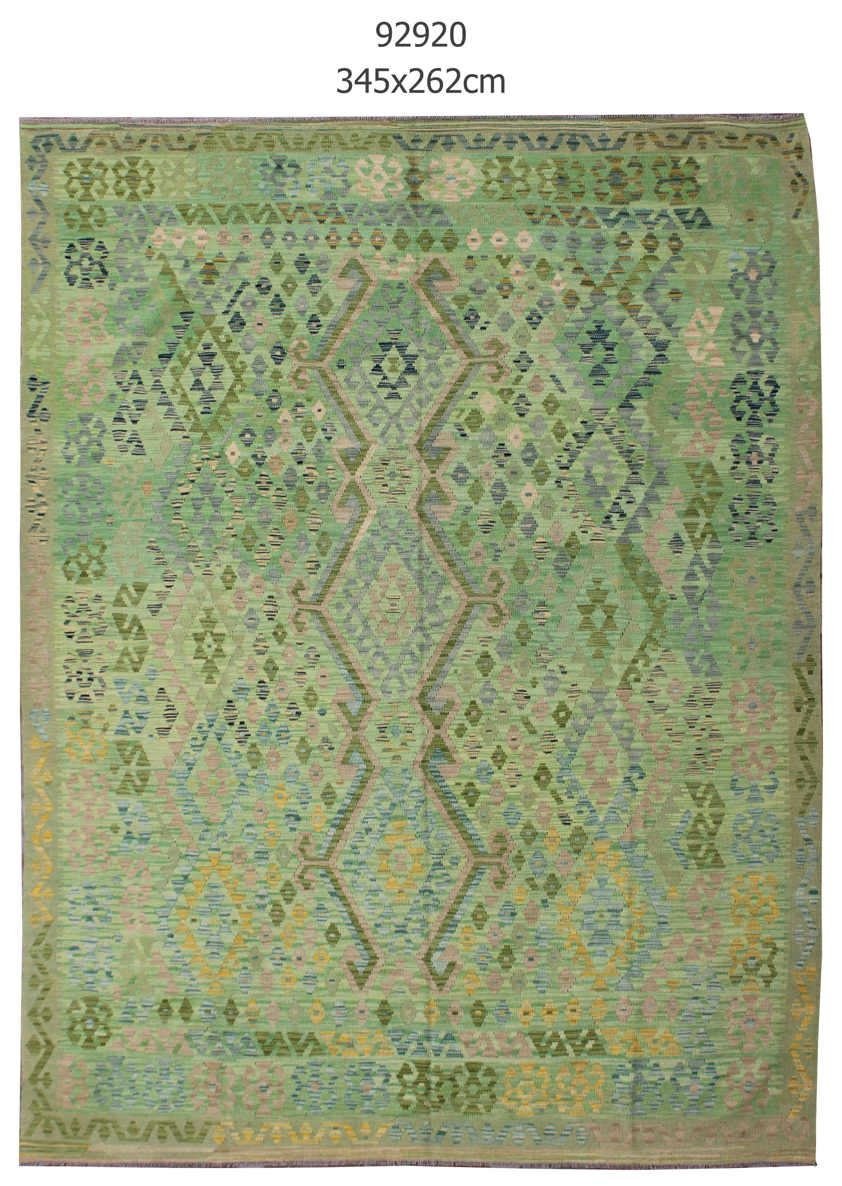
An unusually gentle green palette defines this Afghan kilim rug. Pale yellow, blue-green and cream create nested central diamonds, while smaller dark and light devices spread around them. The principal forms appear gradually because their colours remain close to the surrounding ground. Several patterned bands enclose the field. Tiny repeated shapes along the inner edges contrast with broader, more openly spaced devices farther out. Changes of tone pass horizontally across the surface, giving the green depth and making some motifs clearer in one area than another.
This interaction between the pattern and its background is a large part of the rug's appeal. Flatweaving allows both bold contrasts and quieter tonal relationships. A kilim's pattern is worked into its woven fabric rather than formed from pile knots. In Afghan textile design, geometry can be arranged as a central sequence, an enclosing frame or a fine scatter of small marks.
This piece brings those approaches together without relying on a sharply contrasting accent colour. In a sitting room with pale stone shades or natural wood, this rug could introduce colour while retaining a restful overall effect. Its green would work particularly well with cream linen, muted yellow cushions or a painted cabinet. A simple table would allow the nested central forms to remain visible, while the layered borders could provide interest around the outside of the furniture group and soften the transition to the surrounding floor.