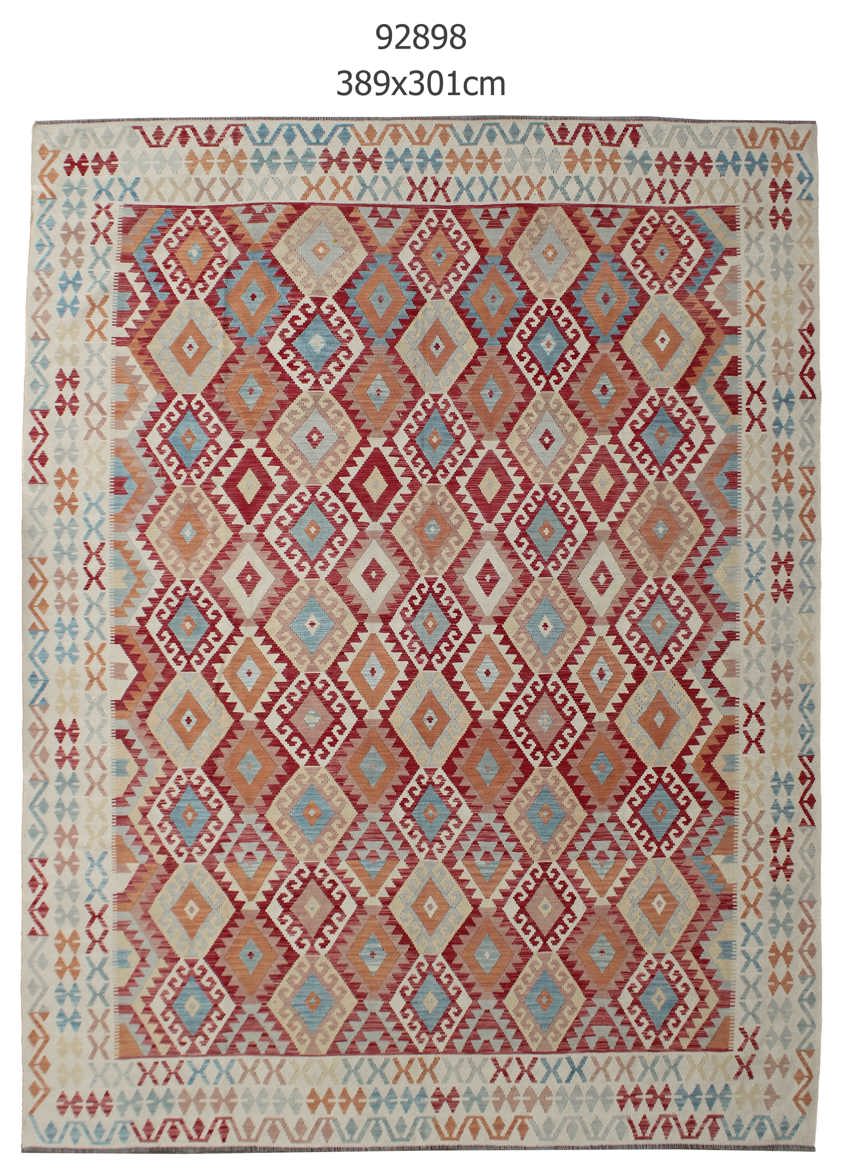
Closely packed diamonds cover the centre of this Afghan kilim rug. Red establishes the main pattern, while pale blue, cream and muted ochre fill smaller inner shapes. Fine hooked lines curl inward around many of the larger units, creating a second layer of ornament within the already intricate arrangement. The light border is deliberately less crowded. Rows of small coloured devices sit against an open ground, allowing the eye to distinguish the perimeter from the busy field. Narrow bands of blue and red tie the sections together. Across the centre, small shifts in colour make individual diamonds more noticeable without disturbing the overall repeat.
The design shows how a flatwoven rug can achieve complexity through the multiplication of relatively simple forms. In kilim construction, the surface is woven rather than built from a knotted pile, and the edges of coloured areas become part of the drawing. Afghan textile design uses this geometric vocabulary in a wide variety of arrangements, from sparse stripes to dense interlocking fields.
In a generously furnished sitting room, this rug would provide a patterned foundation with enough pale detail to keep the red from reading as a solid block. It could accompany oak, tan leather or cream fabric, with blue appearing elsewhere as a quieter accent. The light border would remain an important part of the effect, defining the furniture group and giving the central pattern space around it.