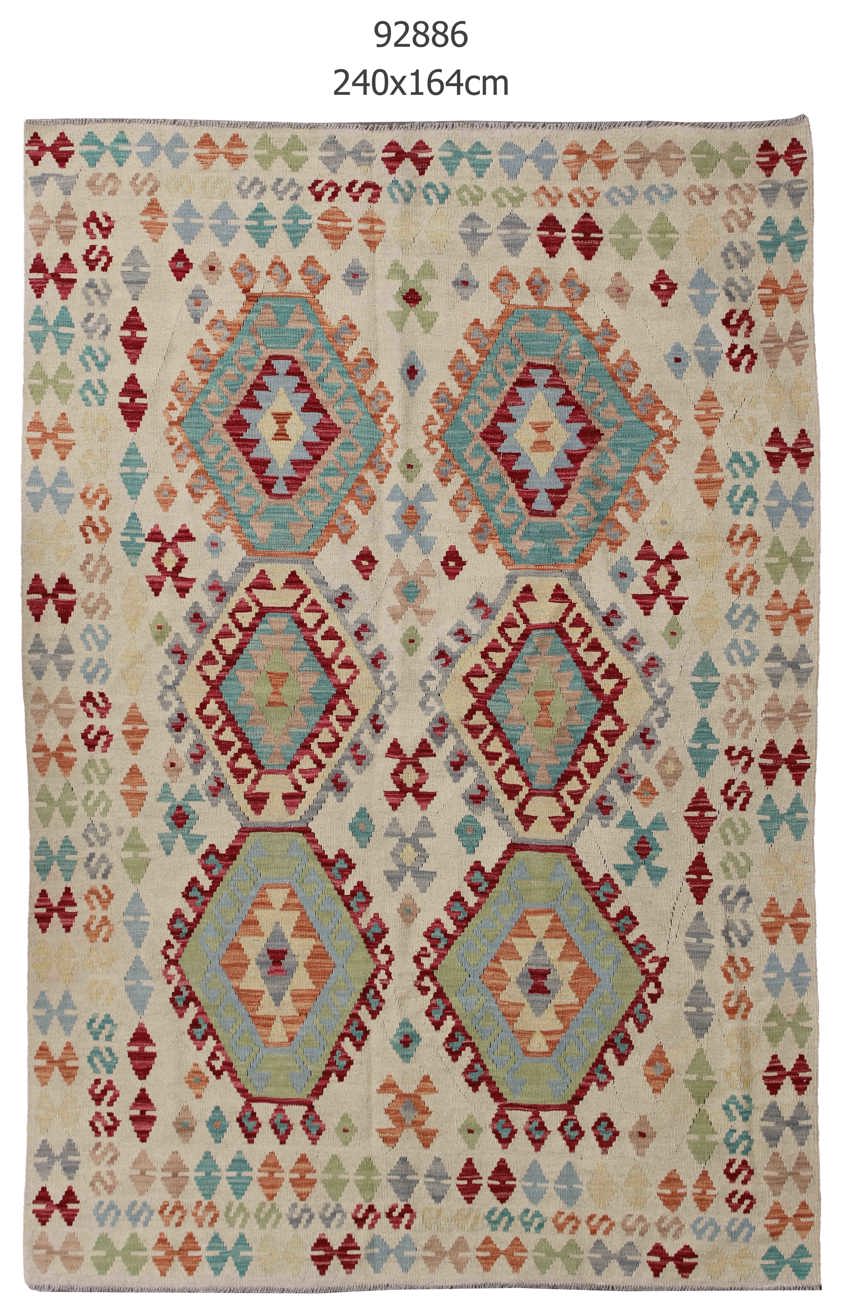
Six large hexagonal forms are arranged in two columns on the cream field of this rug. Their colours shift between turquoise, burgundy, ochre and pale green, with smaller pointed diamonds held inside. The alternating outlines make each unit slightly different, while the repeated shape establishes a clear overall order. Small paired devices surround the main medallions and continue through the outer part of the composition. These details are widely spaced enough for the cream ground to remain prominent.
The contrast between large centres and modest surrounding marks gives the rug a light, almost diagrammatic quality, although the serrated red lines retain a lively traditional character. The use of nested polygons belongs to a broad geometric vocabulary found in Afghan textile art. Kilims are woven without a knotted pile, so their decorative effect depends closely on the placement of coloured yarn and the boundaries it creates. Large shapes can establish the main structure while small repeats knit the spaces between them into the same visual language.
This rug would bring colour to a room without covering the floor in an uninterrupted dark pattern. The cream could connect with pale upholstery, while turquoise suggests blue-green ceramics or a painted cabinet. Burgundy and ochre offer warmer links to wood and leather. Placed where the two columns remain visible, it would create a balanced centre for a relaxed seating area or a bedroom with simple furnishings.