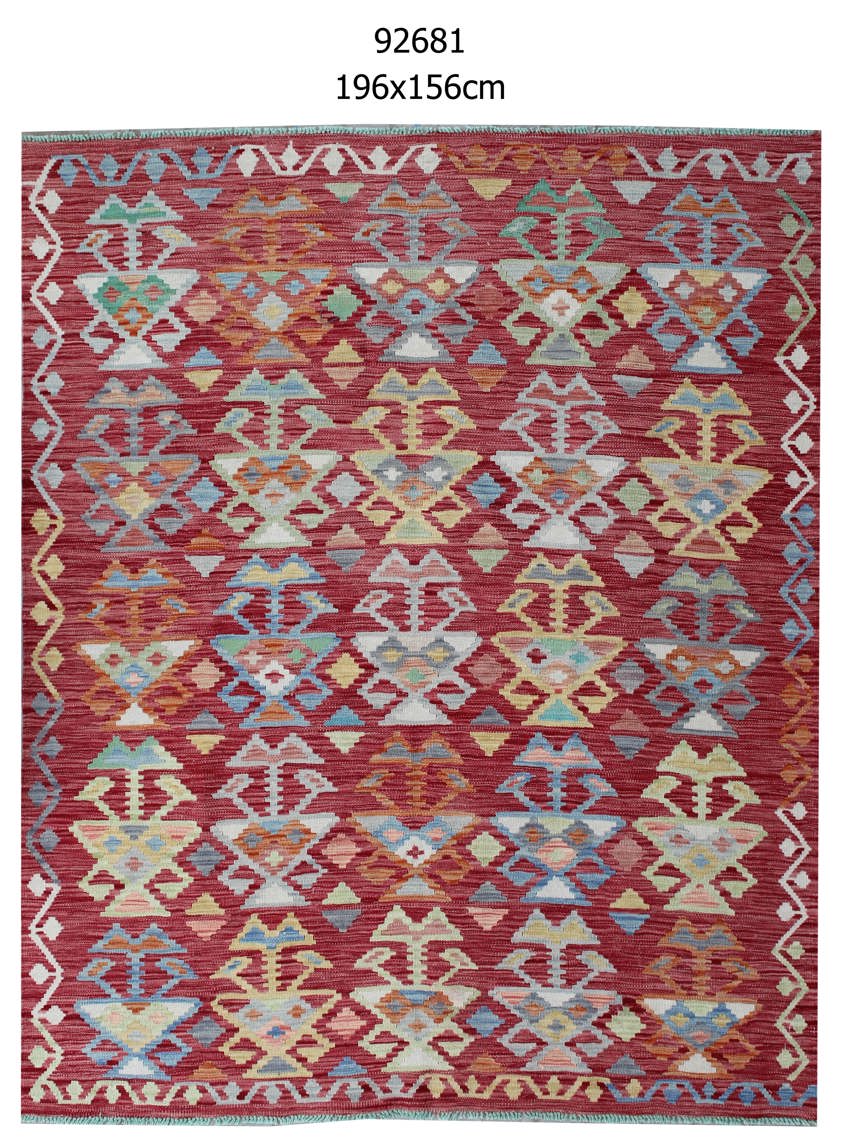
Rows of hooked geometric forms spread across the burgundy ground of this Afghan kilim. Pale green, turquoise, cream and yellow outlines link and overlap, creating a busy horizontal rhythm. Small diamonds sit between the larger figures, while a narrow cream pattern follows the sides. The design avoids a dominant centre, relying instead on the accumulation of repeated shapes and their changing colour relationships. At 196 × 156 cm, this rug has a broad format that suits its all-over composition. The deep red field provides continuity beneath the many lighter motifs.
Fine streaks introduce warmer pink and rust notes, giving the darker areas a varied appearance rather than a single solid tone. The result is rich in detail but held together by a consistent ground. Repeated angular forms are central to many Afghan flatwoven designs. Kilim pattern can develop across a surface through rows and interlocking units, allowing the border to act as a stopping point rather than the main decorative feature.
This example makes especially clear how colour changes can distinguish individual motifs within an otherwise continuous arrangement. It would bring energy to a room with plain seating and simple timber furniture. Cream upholstery could echo the lighter outlines, while a green or blue accessory would relate to the cooler details. Because the pattern is evenly distributed, the rug can remain visually coherent when part of the field is covered by a table or chair.