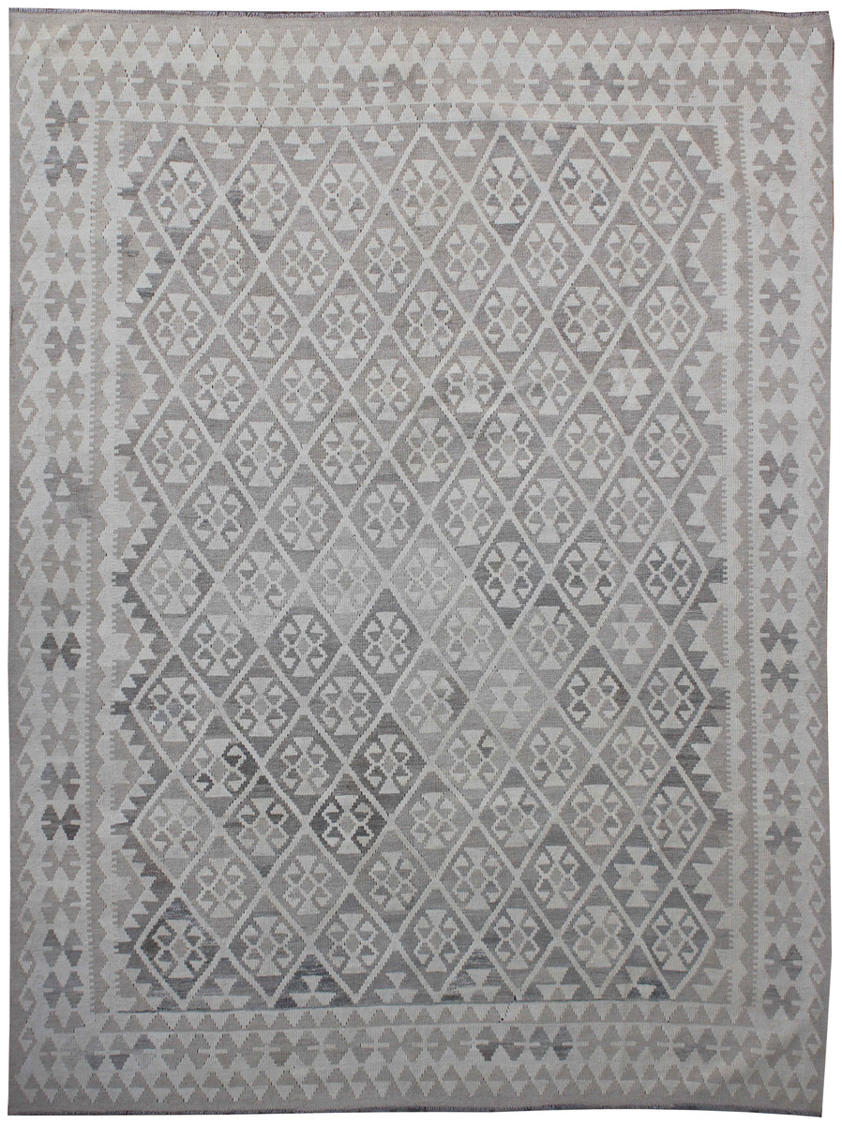
A close diamond lattice fills this Afghan kilim from the inner border to the centre, creating an intricate surface without a single dominant medallion. Small hooked forms sit inside the interlocking compartments, while narrow changes of tone give the pattern a gently shifting appearance. Cream outlines move across a grey ground, and the perimeter repeats compact geometric motifs in several bands. The border is distinct, yet remains closely related to the field. Measuring 339 × 252 cm, this rug has the scale to establish a substantial furniture grouping.
Its restrained palette allows the considerable amount of pattern to register as texture from a distance. Closer inspection reveals the small angular turns that make the lattice feel more animated than a simple grid. The kilim tradition uses flatwoven surfaces for both practical furnishing and decorative expression. Across Afghanistan, geometric textiles form part of a much broader history of domestic weaving. Repetition can create a continuous field, as here, while borders provide a visual stopping point.
Such shared principles accommodate considerable variety, and do not identify an individual weaving community by themselves. In a sitting room, this design could bring definition beneath pale upholstery while leaving space for coloured cushions or artwork. It would also work with dark wood and warm neutral walls. Keeping the main furniture shapes fairly simple would allow the small repeated details to remain an engaging part of the room.