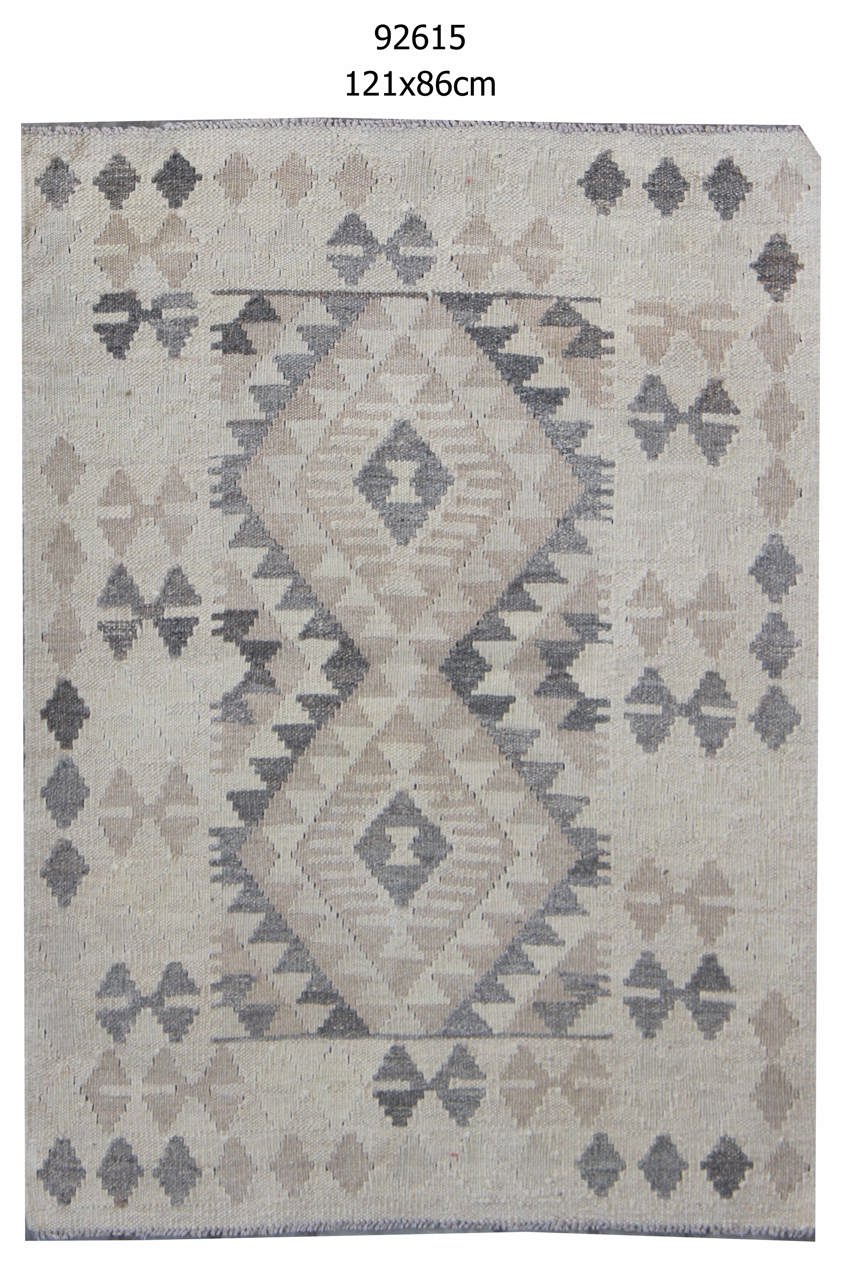
Two stacked diamonds give this Afghan kilim a clear centre, while the surrounding cream ground keeps the composition light. Each medallion contains a smaller dark diamond, enclosed by pale angular bands and a sawtooth outline. Grey, stone and soft beige appear throughout, with small paired shapes placed to either side and loose rows of diamonds near the ends. The darker details are sufficiently spaced to feel like punctuation across the pale surface. At 121 × 86 cm, this rug offers a compact interpretation of a strongly organised geometric design.
Its visual texture comes from the fine horizontal movement within the colours and the slight differences between repeated shapes. The effect is measured rather than rigid: the eye recognises the pattern immediately, then finds small variations within it. Afghanistan has a broad textile heritage encompassing floor coverings, bags and other furnishings. Kilims belong to the flatwoven branch of that tradition, where pattern is carried by the woven surface rather than a deep knotted pile.
Diamonds and stepped contours form part of a wider regional design vocabulary, interpreted through changing proportions and colour relationships. This example would sit comfortably beside a reading chair, at the side of a bed or in a small study. Pale oak, chalky paint and linen would echo its softer tones; a charcoal chair or dark timber cabinet could pick up the concentrated grey accents without overwhelming the room.