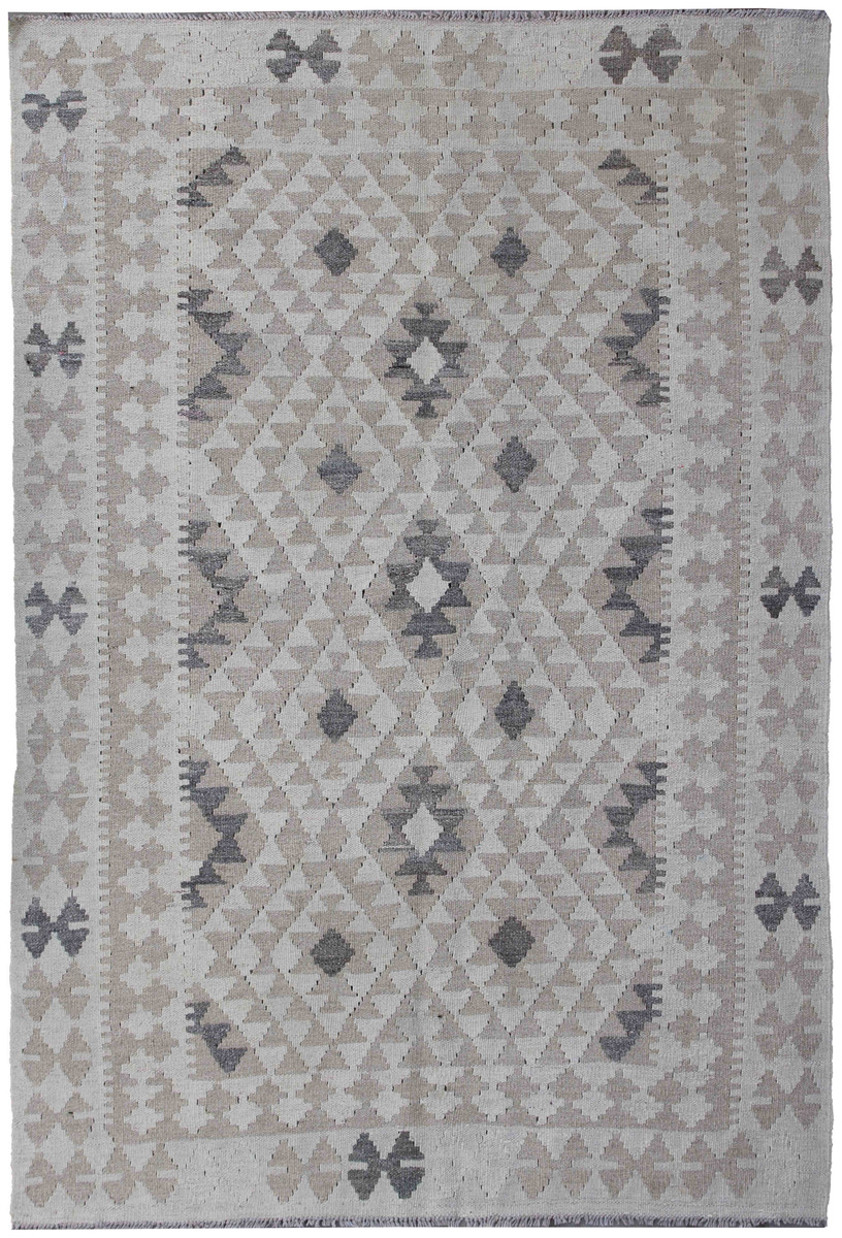
Small triangles form a close pattern across the middle of this rug. Within that pale grey field, darker lozenges and compact angular figures appear at intervals, creating separate points of emphasis rather than a single dominant medallion. Darker stepped shapes follow portions of the sides. A light rectangular frame contains the interior, beyond which paired figures and little lozenges continue towards the edges. The palette stays close to ivory, taupe and grey. Fine horizontal changes are visible through the larger pale passages, giving the ground a gently streaked appearance.
Dark accents are concentrated in a few centres and outer figures, so the rug has considerable detail without the same contrast everywhere. Afghan domestic textiles make extensive use of geometric forms, adapted to rugs and smaller household furnishings. A little triangle can become an infill pattern, while a lozenge may stand alone as an accent or grow into a larger centre. This rug gives particular weight to the finer repeat, allowing the scattered darker figures to emerge through it.
Measuring 174 × 118 cm, it could suit a study or an open bedside area. Plain cream upholstery would relate to the field, while a charcoal accessory could answer the strongest details. Pale timber would introduce warmth beside the grey. Keeping the outer frame visible would show the shift from the densely patterned interior to the more widely spaced figures around it.