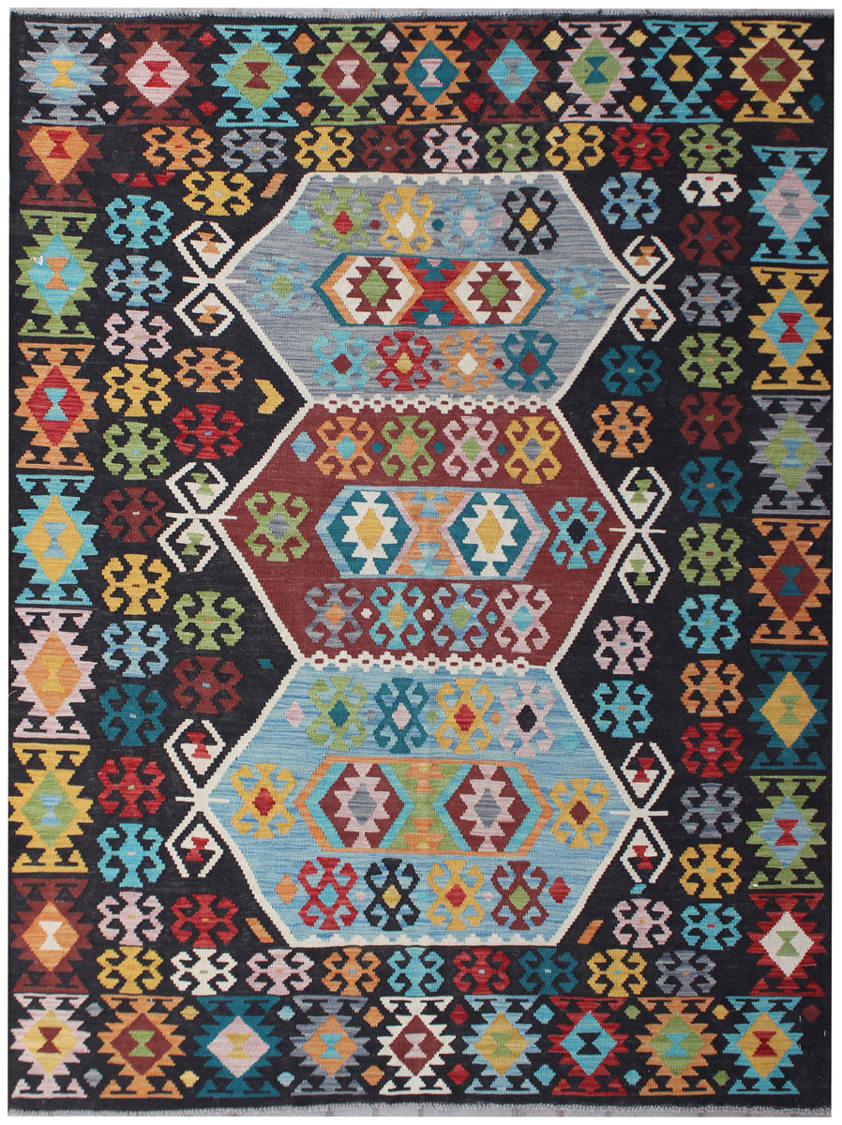
Three large hexagons occupy the black field of this rug. Pale blue fills the upper and lower compartments, while the middle medallion is predominantly red. Each contains horizontal bands of small diamonds, curled forms and angular accents in yellow, cream, green and deeper blue. Pale outlines join the three centres into a continuous vertical sequence. The surrounding black spaces carry their own lively pattern of little hooked and curled figures. Broad side bands introduce bright stepped lozenges, and the ends continue the same vocabulary at a smaller scale.
The contrast between those outer repeats and the more expansive hexagons gives the rug several distinct layers of detail. At 239 × 178 cm, this rug could provide a strong focus for a sitting room. Plain pale upholstery would echo the medallion outlines, while a red chair or a blue textile could relate to the larger compartments. An open framed table would leave more of their banded interiors visible than a broad solid base. Afghanistan's geometric textiles include both floor coverings and smaller pieces used within the home.
Angular enclosures can hold a succession of smaller figures, or repeat as a pattern in their own right. This rug combines both approaches: the main hexagons act as containers for varied bands, and the border lozenges create a separate repeat. The black ground connects them, giving the many colours a consistent setting from the centre to the edges.