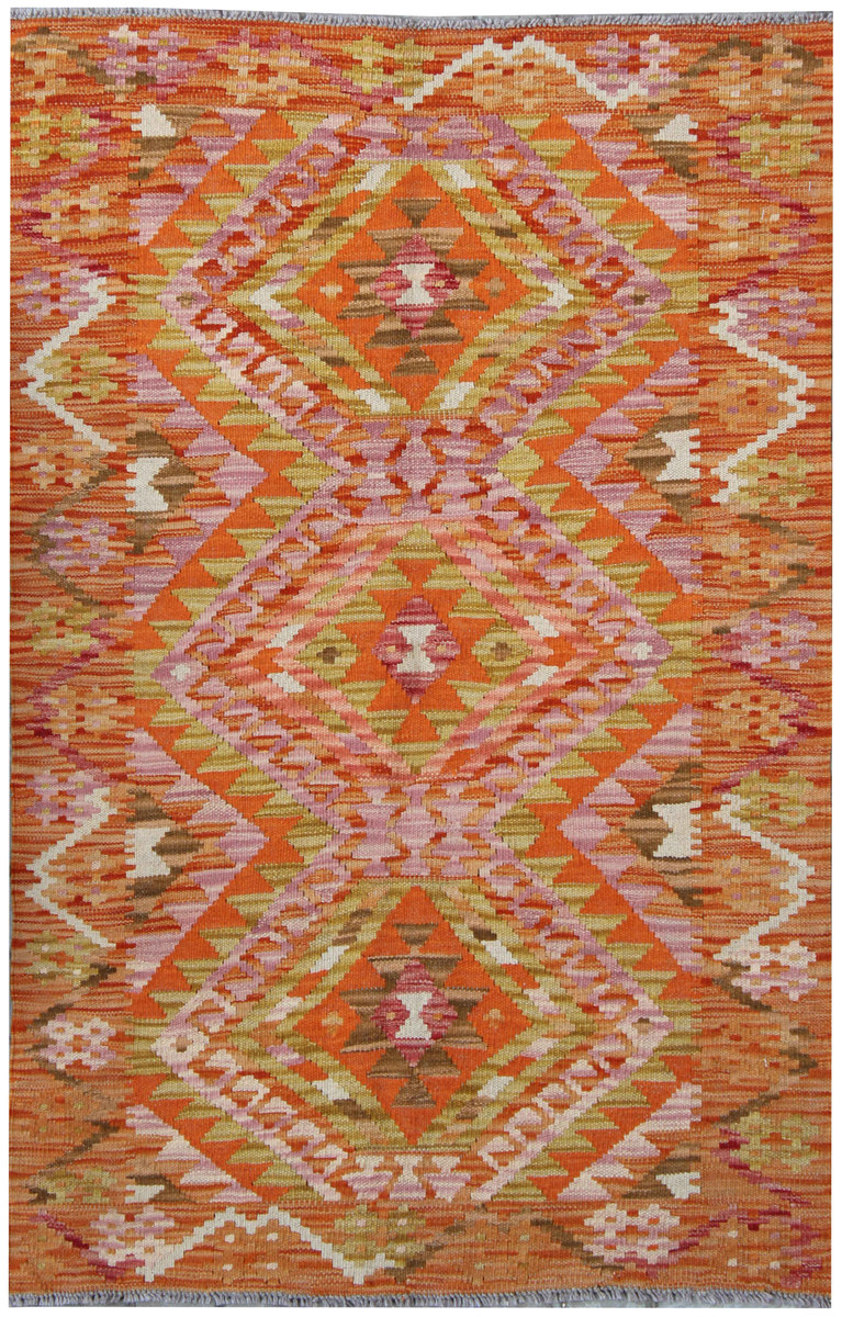
Three diamond medallions fill the length of this rug, each centred on a compact orange and green arrangement. Lilac, cream and rust outlines expand around them in successive stepped bands. Little pale lozenges and angular figures occupy the spaces at the sides, while narrow blue grey lines finish the ends. There is no broad enclosing border to interrupt the movement between the main shapes and the surrounding field. The colours are particularly varied. Orange passes through redder and yellower streaks, green appears in both the medallions and their outlines, and the pale accents make a series of small bright points.
Close inspection reveals the many fine horizontal changes that prevent any one passage from appearing entirely uniform. At 153 × 97 cm, this rug could enliven a reading corner or sit beside a bed, where its three part arrangement would remain easy to see. A warm plain floor would keep the orange connected to its setting. Cream linen or a muted green chair would pick up individual colours without competing with the medallions.
Afghanistan's geometric textile traditions encompass rugs, bags and other household pieces. Repeated lozenges are one of the forms shared across those different objects, with their proportions and internal details adjusted to suit the available space. On this rug, a narrow format concentrates the design into a strong vertical sequence. The smaller side figures allow that sequence to open out towards the edges instead of becoming an isolated central strip.