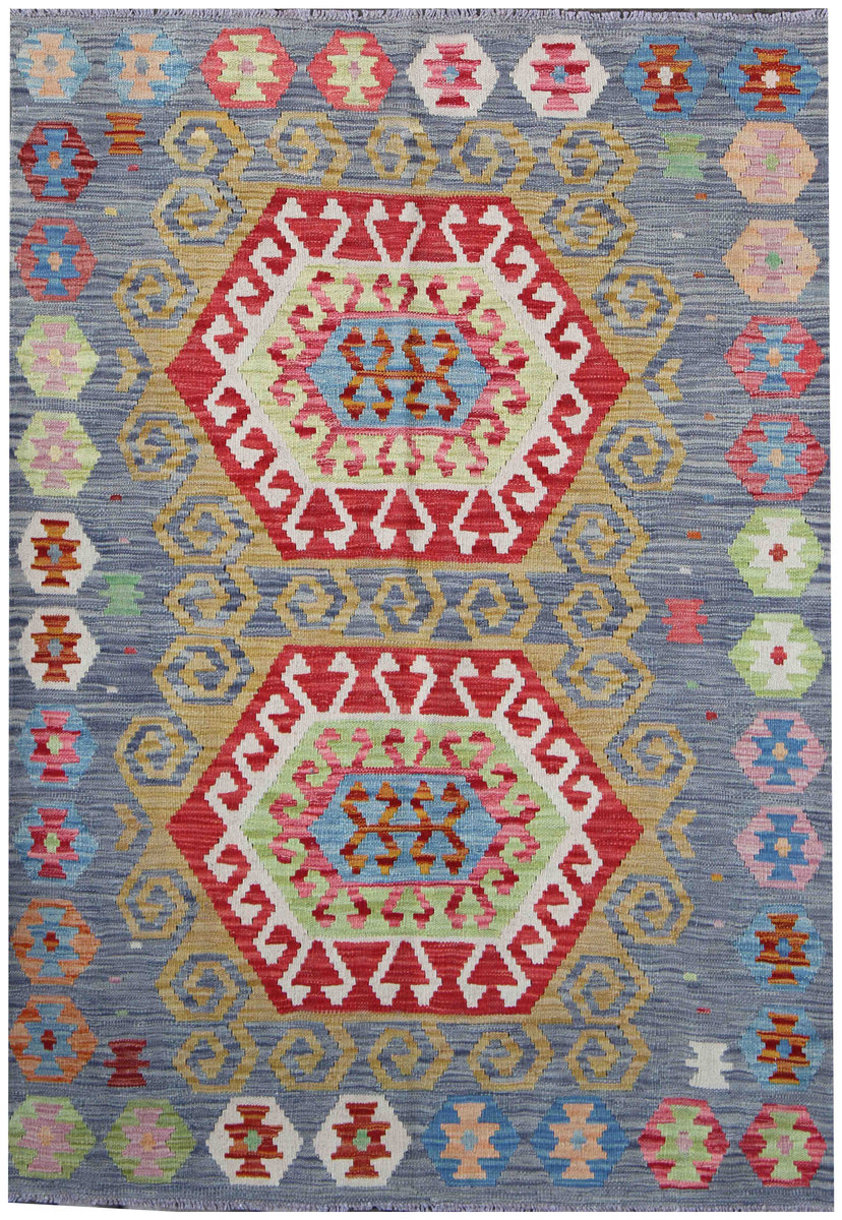
Two red hexagons stand out against the slate blue field of this rug. Cream hooked outlines surround their pale green and turquoise interiors, where little angular figures repeat in contrasting rows. Ochre scrolls make a loose enclosure around the pair, and small multicoloured medallions occupy the outer edge. The blue ground remains visible between these different levels of pattern. At 180 × 123 cm, this rug could bring a complete decorative composition to a study or small sitting area. Its red would work with darker timber, while the blue and green offer gentler options for fabrics. A plain cream chair could echo the strongest outlines.
The two centres are large enough to retain their identity from a distance, despite the compact format. Afghan kilims form part of a broader household textile culture in which repeated geometric units can be combined at several scales. Hooked outlines, angular scrolls and small medallions also appear in other woven furnishings, with their proportions changing according to the design. This example gives each a distinct position around the paired centres.
Fine tonal variation through the blue softens the otherwise emphatic drawing. The ochre scrolls are especially appealing on closer inspection, lending the central group a more flowing boundary than a straight frame would provide. Keeping the middle largely open would reveal the relationship between those scrolling lines and the more tightly contained red hexagons.