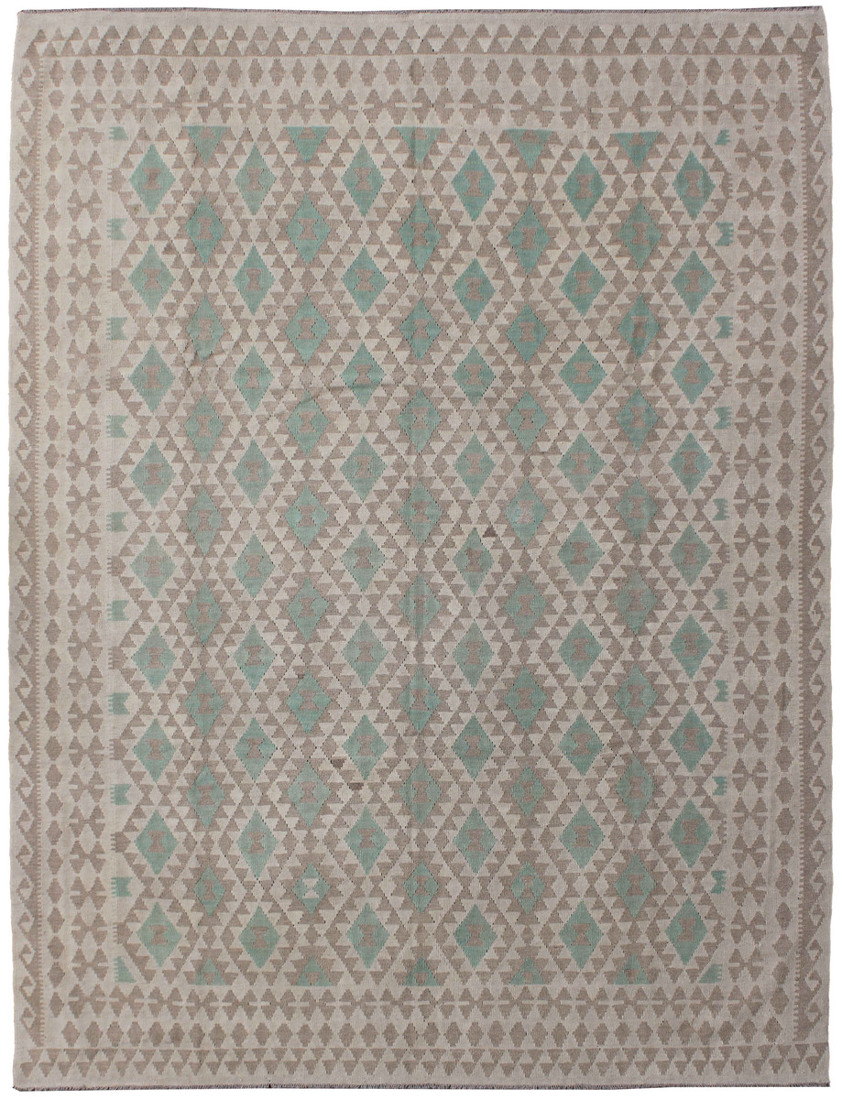
Mint green diamonds repeat across an ivory ground on this rug, their stepped taupe surrounds creating a close geometric lattice. The colours are deliberately gentle, so the pattern emerges through subtle contrasts rather than strong outlines. Several narrow border bands contain tiny lozenges and angular figures, giving the outer frame more detail than its quiet palette might first suggest. At 333 × 254 cm, this rug has enough breadth to connect a generous seating group. Ivory upholstery would continue the ground colour, while pale oak or warm stone tones would sit comfortably beside the taupe drawing.
The mint could be echoed in a fabric without introducing a dominant accent. Because the pattern extends across the field, furniture can overlap the centre while leaving a coherent repeat visible around it. Afghan kilims are part of a much wider domestic textile history. Geometric patterns appear on floor coverings and smaller household weavings, with repetition offering a way to organise a surface at many different scales.
In this example, the lozenge is repeated closely enough to become an overall pattern, rather than serving as an isolated emblem. The fine visual grain within the colours gives the light areas texture and prevents the ivory from appearing blank. The little border motifs also provide a useful change of pace. Their smaller scale holds the field within a precise frame while allowing the mint diamonds to remain the principal decorative element.